

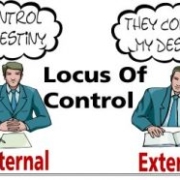
According to psychologist Rotter, locus of control is a widely used topic in psychology and affects an individual’s perspective and the way they interact with their environment. Rotter, in 1966, proposed «locus of control» as a personality trait in his Social Learning Theory.
«If the person perceives the event as contingent on their behavior or their own relatively permanent characteristics, this has been called a belief in internal control.» Conversely, «when a reinforcement is perceived as following some personal action, but not being entirely contingent on it, it is typically perceived, in our culture, as the result of luck, and in this sense, it has been called a belief in external control.»
—Rotter, 1966
According to Rotter’s Social Learning Theory, which preceded Albert Bandura’s, human behavior occurs through a continuous interaction between cognitive, behavioral, and environmental determinants. Therefore, a person’s perception of control or lack of control over the events that occur around them is important for the course of their own life.
Locus of control is a relatively stable personality variable that represents the attribution a person makes about whether or not the effort they expend is contingent on their behavior. There are two extremes of the continuum: internal locus of control and external locus of control.

Internal locus of control occurs when an individual perceives that a specific reinforcing event is contingent on their own behavior. That is, the person perceives that what has happened externally is due to their behavior, and they have control over the external consequences. For example, a person with an internal locus of control attributes their happiness to themselves. If they want to be happy, they can work on it.
External locus of control occurs when an individual perceives that an external event has occurred independently of their behavior. Therefore, the individual associates the event with chance, luck, or destiny. For example, a person with an external locus of control attributes their happiness to another person or the situation.
This concept is important because if a person believes that what happens around them is beyond their control, they may not act to change it. For example, if a person believes they have no control over the election of the political party that will govern their country, they may do nothing to change it, not even exercising their right to vote. On the other hand, if a person believes their vote will be important in the election of a new government, they may be motivated to change the political landscape and may even protest.
The feeling of not being able to control an event often creates a state of paralysis that prevents people from achieving their goals.
Internal locus of control is also an important aspect of personal development, as a person with an internal locus of control believes in their capabilities in the face of external events and knows that by putting in the best effort they will go far.
The literature presents a series of behavioral traits attributed to successful entrepreneurs, but one of the most important is Internal Locus of Control.
 We have already seen the difference between internal locus of control and external locus of control, and that this implies that I, as a person, attribute my success and failure to my own actions, to my own initiatives. This is called internal locus of control, while external locus of control implies that I, as a person, attribute the results I have in life to luck, to fate, to other external factors, and to my actions.
So you can already imagine that a successful entrepreneur, a businessman, is a person with a high internal locus of control; a person who takes responsibility for their success and failure.
Another characteristic that’s important to mention has to do with initiative. We say the world is full of good intentions, but truly, those who carry them out are those who can be called entrepreneurs. It’s like innovation: you can have many ideas and even inventions, but implementing them, getting the market to accept them, is only then innovation. So, implementing your ideas, getting the market to accept them, is what will truly define you as an entrepreneur.
Not everyone is qualified to be an entrepreneur; launching a project requires specific personal and professional characteristics. Being an entrepreneur also means having the motivation and financial means to succeed.
Generally speaking, in addition to the internal locus of control, an entrepreneur should possess the following qualities:
Creativity and innovation
Clarity of ideas
Ability to confront and assume risks
Ability to adapt to new situations
Knowing how to prioritize
Ability to communicate and socialize
Tenacity and persistence
Flexibility and ability to adapt to circumstances
Optimism
Believing that everything that happens to us is a product of chance, of others, of our destiny, of decisions we made in the past that we can no longer change; that we have to accept whatever happens to us or live frustrated, believing that the rest of the world is to blame for us not achieving our goals—these are mistakes that are as common as they are disastrous.
On the other hand, nothing is more mature and reassuring than a responsible person capable of taking responsibility for their actions and their consequences.
Someone capable of saying, «I was wrong,» «I’m sorry,» or, on the other hand, «I achieved this with great effort,» «I deserve this because I worked for it,» for example, is a person who conveys maturity, wisdom, and, very importantly, calm to others.
As a general rule, we tend to assume our successes as our own responsibility, but our failures as something that is the fault of others (remember the «I wasn’t lucky vs. I got it»?), although it is also very common to find people who, either due to a lack of self-esteem or because they confuse the concept of humility, never acknowledge or take credit for success, even if it is the result of many hours of work.
Have you ever wondered who is really responsible for your success?
In this video, we explore the concept of «locus of control» and how it influences entrepreneurship. You’ll learn the difference between internal and external locus of control through everyday examples and how this concept can be the key to transforming your life and business