


There Are Only 3 Ways to Stand Out: How to Compete in a Saturated Market

We live in a time when competition grows fiercer by the day. Whether you’re an ambitious startup, a well-established small business, or a multinational corporation, it’s increasingly difficult to win your customer’s attention, loyalty, and trust.

In this landscape, differentiation is no longer a marketing tactic — it’s a matter of survival. And yet, despite its importance, most businesses misunderstand what being “different” actually means.

Real differentiation is not about reacting to your competitors with a similar product and a personal twist. That strategy only turns you into a follower. To truly stand out, you must build something from the ground up, anchored in deep understanding — not of market trends, but of the unspoken problems your customers face.

Although there are dozens of theories about competitive differentiation, in practice, only three viable paths exist. And each is defined by how customers perceive you:

  1. Be the Cheapest
  2. Be the Best
  3. Be the Only One
  1. Be the Cheapest: A Risky Strategy

In many markets, when competition tightens, the first instinct is to drop prices. It feels intuitive — if your product is similar to others, the one with the lowest price wins, right? But what seems obvious is often dangerous.

Competing on price is only sustainable for those who completely redefine costs or leverage massive scale. Think of Amazon — their success in pricing lies in optimized logistics, large-scale automation, and a tech-driven ecosystem that small businesses simply can’t replicate.

Price leadership demands ruthless efficiency, capital for constant innovation, and volume-driven margins. It’s not just about selling cheap — it’s about operating cheap without sacrificing value. Most startups and SMEs don’t have this kind of infrastructure and will suffer deep financial stress if they choose this path without true cost innovation.

In short: being cheap isn’t bad — it’s just a game designed for the few who can afford to play it well.

  1. Be the Best: The Illusion of Superiority

The second route is striving to be “the best.” This is the default aspiration for many — make the highest quality product, offer the best service, be better than the market leader. But there’s a hidden trap in this approach.

Trying to beat the leader often means playing by their rules. You mimic their standards, their benchmarks, and even their assumptions about what matters. But why adopt their worldview? Why fight their battles instead of creating your own?

Moreover, «the best» is subjective. Customers rarely choose the best technical solution; they choose what resonates emotionally, culturally, or experientially. Being better might not make you stand out — it might just make you invisible in a crowd of excellence.

This strategy is not inherently wrong, but it’s limited. If you’re not the leader, fighting them on their terms often becomes an uphill battle with diminishing returns.

  1. Be the Only One: The Boldest, Smartest Path

Now we arrive at the path that’s both the hardest and the most rewarding: being the only one.

To be the only one doesn’t mean inventing a radical new technology or finding a “blue ocean” without competition. In fact, most “blue oceans” are just blind spots. Instead, being the only one means building your value proposition from first principles — not from market reports or benchmarking studies.

It means stepping off the beaten path, rejecting industry norms, and going straight to the source: the customer. Not to ask what they want (because people often don’t know), but to understand what frustrates them, what they’re settling for, and what no one is solving.

When you’re the only one who offers something — a unique point of view, a distinctive model, a radically human approach — competition becomes irrelevant. You don’t compete. You become incomparable.

Companies like Canva, Notion, or even Patagonia weren’t always the best or the cheapest — they were simply different in ways that mattered deeply to their customers.

There Is No Middle Ground

Trying to mix these strategies is like trying to serve two masters — it leads to confusion, diluted messages, and ultimately, mediocrity.

As Seth Godin says:

“The opposite of extraordinary isn’t bad — it’s very good.”

And that’s the real threat: to be very good, but not unforgettable. To be competent, but not chosen.

The Courage to Be Different

True differentiation is terrifying. It demands self-awareness, vulnerability, and a clear sense of purpose. But it’s also liberating — because when you stop chasing your competitors and start chasing your convictions, you create something truly valuable.

Being “the only one” is a lonely road. There’s no map, no precedent, no safety net. But if it brings you closer to solving your customer’s real problems, then it’s the right path.

There are only three ways to differentiate. And only one leads to meaningful distinction: the path of authenticity, empathy, and bold conviction.

There Are Only 3 Ways to Stand Out: How to Compete in a Saturated Market

References (APA Style)

Godin, S. (2018). This is Marketing: You Can’t Be Seen Until You Learn to See. Portfolio/Penguin.
Kim, W. C., & Mauborgne, R. (2015). Blue Ocean Strategy: How to Create Uncontested Market Space and Make the Competition Irrelevant. Harvard Business Review Press.
Osterwalder, A., Pigneur, Y., Bernarda, G., & Smith, A. (2014). Value Proposition Design: How to Create Products and Services Customers Want. Wiley.
Christensen, C. M. (1997). The Innovator’s Dilemma: When New Technologies Cause Great Firms to Fail. Harvard Business Review Press.

From Ada Lovelace to the Internet: The Collaborative Legacy of Digital Innovation

In the 21st century, technological innovation is often seen as the product of solitary geniuses working in isolation. Yet, as Walter Isaacson reveals in The Innovators, the greatest advancements of the digital age stemmed not only from individual brilliance but from deep collaboration across disciplines, generations, and institutions. This article explores how key figures like Ada Lovelace, Alan Turing, and J.C.R. Licklider helped shape our digital world—and how teamwork, more than lone genius, has been the driving force behind technological revolutions.

Ada Lovelace: Beyond Numbers

Ada Lovelace, daughter of poet Lord Byron, is recognized as the world’s first computer programmer. In the mid-19th century, she worked with Charles Babbage on his analytical engine—a theoretical computing device. What made Ada exceptional was not just her math skills, but her visionary insight. As Isaacson (2014) explains, Ada foresaw that such a machine could manipulate not only numbers but also music, words, and symbols—planting the seed for modern computing.

In her famous “Note A,” Ada introduced four ideas that would shape the future: the concept of a programmable universal machine, the manipulation of symbolic information, the structure of computer algorithms, and the philosophical question of artificial intelligence. Even Babbage didn’t fully grasp the broader implications of his invention—but Ada did.

Alan Turing and the Birth of the Modern Computer

A century later, Alan Turing would build on Ada’s legacy. He proposed the «universal machine»—a theoretical computer capable of executing any logical operation. During World War II, Turing led a team at Bletchley Park to break the Nazi Enigma code, showcasing the power of collaborative innovation.

Turing also raised the possibility of machine intelligence. His famous “Turing Test” asked whether a machine could imitate human behavior well enough to be indistinguishable from a real person. This test remains a foundation of modern artificial intelligence philosophy (Hodges, 2014).

The Forgotten Women of the ENIAC

In the 1940s, six pioneering women—Jean Jennings Bartik, Marlyn Wescoff, Ruth Lichterman, Betty Snyder, Frances Bilas, and Kay McNulty—were assigned to program the ENIAC, the world’s first general-purpose electronic computer. Initially dismissed because of their gender, they proved that programming was just as crucial as building hardware.

These women used patch cords and switches to reprogram the ENIAC for different tasks, effectively inventing early programming techniques such as subroutines and modular design (Abbate, 2012). Their story reminds us that innovation is not only about hardware—but also about human determination and ingenuity.

Science, Government, and Industry: The Birth of the Internet

One of the most powerful examples of collective innovation came with the birth of the Internet. In his 1945 report Science: The Endless Frontier, Vannevar Bush argued that government funding for basic science would fuel economic progress. This led to the creation of the National Science Foundation and other institutions that funded early computer networks (Bush, 1945).

J.C.R. Licklider, a psychologist and visionary at ARPA, imagined a decentralized network of interactive computers. His ideas laid the foundation for ARPANET, the forerunner of today’s Internet. Other figures like Robert Taylor, Larry Roberts, and Leonard Kleinrock contributed to developing packet-switching and decentralized infrastructure—key elements of the web we use today (Isaacson, 2014).

Counterculture Meets Silicon Valley

In the 1960s and 70s, the San Francisco Bay Area became a hotbed of creative experimentation. Influenced by the counterculture, people like Stewart Brand advocated for computers as tools of personal empowerment, not just corporate or military control. The invention of the microprocessor made it possible to put a computer in every home.

Steve Jobs and Steve Wozniak, deeply influenced by this ethos, founded Apple with the mission of democratizing technology. As Isaacson (2014) explains, the personal computer was not just a product—it was a social revolution built on community, creativity, and idealism.

Conclusion

The Innovators is more than a chronicle of digital technology; it’s a tribute to the power of collaboration. From Ada Lovelace’s poetic algorithms to Licklider’s vision of a human-computer symbiosis, and the human stories behind programming and networks, innovation has always been a team effort. In an age that idolizes the lone genius, Isaacson reminds us: the true revolutionaries work together.

From Ada Lovelace to the Internet The Collaborative Legacy of Digital Innovation

References

Abbate, J. (2012). Recoding gender: Women’s changing participation in computing. MIT Press.

Bush, V. (1945). Science: The endless frontier. United States Government Printing Office.

Hodges, A. (2014). Alan Turing: The enigma. Princeton University Press.

Isaacson, W. (2014). The Innovators: How a Group of Hackers, Geniuses, and Geeks Created the Digital Revolution. Simon & Schuster.

Digital Crisis: From Fear to Technological Mastery

In today’s digital era, technology is not optional—it’s essential. Yet many businesses still view IT as a complex realm reserved for experts. This misconception fuels a silent crisis: failed digital transformations. But what if you could understand technology as simple, logical, and accessible? This article invites you to demystify the digital world and adopt technology as a daily habit essential to successful leadership.

Understanding Technology from the Ground Up

It all starts with recognizing one key truth: computers don’t think—they follow instructions. That’s precisely why you shouldn’t fear them. Learning how they work—from the CPU that processes data to the servers hosting websites—empowers you to make informed decisions. The foundation of any successful digital transformation is a solid grasp of basic concepts like data flow, storage, and processing. You don’t need to become a programmer—just understand how digital tools work.

Making Technology a Habit

Digital success isn’t about having the latest software—it’s about making technology instinctive. When technology becomes part of your daily workflow, you gain independence, streamline operations, and take control of results. Mastering the basics helps any leader manage more effectively. You don’t have to be a tech expert, but understanding how technology supports your goals is critical.

Demystifying Programming and Code

Who said programming is only for geniuses? HTML and CSS, for example, are accessible languages anyone can learn. Creating a basic web page is as easy as writing an email. This marks the beginning of a digital mindset—understanding the language machines use so you can communicate with them. Programming isn’t magic; it’s pure logic. Once you see this, technology loses its intimidation factor.

Digital Transformation: Beyond Technology

One major mistake companies make is assuming digital transformation means installing new platforms. In reality, transformation happens when everyone in the organization uses technology naturally. Many initiatives fail because they lack clarity on the real problems to solve or rely too heavily on consultants without internal understanding. Leading digital change means knowing enough tech to steer projects and make wise decisions.

Technological Leadership: The Real Game-Changer

True organizational change comes from the top. Leaders who don’t understand tech become passive spectators. On the other hand, leaders who grasp the basics can confidently guide their teams, avoid unnecessary costs, and maximize every tool. In the digital age, leadership isn’t optional—it’s essential. Leaders must foster a culture where everyone sees technology as a helpful ally.

Practical Applications and Mistakes to Avoid

Technology solutions don’t have to be expensive or complex. Automating repetitive tasks or using dashboards for data-driven decisions are just some accessible options. But beware of common pitfalls: investing in trendy tools without clear purpose, relying blindly on consultants, or acquiring systems you don’t understand. The only valid transformation is the one that solves real problems with useful, well-understood tools.

Conclusion

The “digital crisis” is not a software issue—it’s a comprehension issue. Overcoming it doesn’t require advanced degrees, just a willingness to learn and lead logically. If you understand how tech works, you can use it to grow. Real digital transformation happens when using technology isn’t a thought—it’s a habit. And you are more than ready to lead it.

Digital Crisis From Fear to Technological Mastery

References 

  • Brynjolfsson, E., & McAfee, A. (2014). The Second Machine Age: Work, Progress, and Prosperity in a Time of Brilliant Technologies. W. W. Norton & Company.

  • Chui, M., Manyika, J., & Miremadi, M. (2016). Where machines could replace humans—and where they can’t (yet). McKinsey & Company. Retrieved from https://www.mckinsey.com

  • Davenport, T. H., & Redman, T. C. (2020). Digital transformation comes down to talent in 4 key areas. Harvard Business Review. Retrieved from https://hbr.org

  • Kotter, J. P. (2012). Leading Change. Harvard Business Review Press.

  • Martínez, J. L. (2022). Digital Transformation for All: Simple Strategies to Lead in the Tech Era. UOC Publishing.

  • Negroponte, N. (1995). Being Digital. Vintage.

  • Prensky, M. (2001). Digital Natives, Digital Immigrants. On the Horizon, 9(5), 1–6. https://doi.org/10.1108/10748120110424816

  • Tapscott, D. (2009). Grown Up Digital: How the Net Generation is Changing Your World. McGraw-Hill.

Añade aquí tu texto de cabecera

Ways to Generate Income: Which One Is Right for You?

In a constantly changing economic landscape, more people are asking: What’s the best way to generate income? The answer depends on personal goals, lifestyle, and risk tolerance. Understanding the advantages and disadvantages of each income model will help you make smarter financial decisions.

Let’s explore the four main income paths: traditional employment, freelancing, entrepreneurship, and passive income. Each offers unique benefits and challenges.


1. Traditional Employment

Advantages:

  • Stable and predictable income (fixed salary).
  • Benefits such as health insurance, vacation, bonuses, etc.
  • Low financial risk.
  • Structured work environment with clear processes.

Disadvantages:

  • Limited flexibility in schedule.
  • Limited control over career growth or salary increases.
  • Risk of layoffs or corporate restructuring.
  • Less autonomy and creativity in decision-making.

Best for: Those seeking stability, benefits, and a clear work structure.


2. Freelancing / Independent Work

Advantages:

  • More freedom with schedule and location.
  • Control over which projects to take on.
  • Potential to earn more if well-managed.
  • Continuous skill development.

Disadvantages:

  • Unstable and unpredictable income.
  • No access to employment benefits.
  • Requires strong self-management and sales skills.
  • Requires investment in training and marketing.
  • High responsibility for results and deadlines.

Best for: Self-motivated individuals with specialized skills and a desire for freedom.


3. Entrepreneurship (Starting Your Own Business)

Advantages:

  • High potential for growth and scalable income.
  • Full control over decisions and business direction.
  • Opportunity to build a personal brand or legacy.
  • Emotional satisfaction from creating something of your own.

Disadvantages:

  • High financial risk, especially at the beginning.
  • Significant investment of time, money, and energy.
  • Uncertainty during the early stages.
  • Emotional pressure from stress and responsibilities.

Best for: Innovators with a high tolerance for risk and a strong desire for independence.


4. Passive Income (Rentals, Investments, Royalties)

Advantages:

  • Earnings without constant work.
  • Long-term financial freedom.
  • Opportunity to accumulate wealth over time.
  • Can be combined with other income types.

Disadvantages:

  • Requires initial investment of time or capital.
  • Risk of losses in volatile markets.
  • May take years to build reliably.
  • Requires solid financial literacy.

Best for: Individuals with capital to invest or long-term financial planning goals.


The Power of Independence and Entrepreneurship

While each income path has pros and cons, independent work and entrepreneurship offer something unique: freedom. Freedom to choose, to create, and to not depend on a single paycheck.

In today’s dynamic world, the ability to rely on your skills and create your own opportunities becomes a strategic advantage. It’s not easy—but it can lead to a life that’s more creative, flexible, and fulfilling.

Most entrepreneurs start with thousands of dollars in startup costs: hiring staff, investing in marketing, quitting their jobs, and building their own systems. But with the right mindset and support, they can create a future that truly reflects their values.


Support and Tools to Help You Succeed

You don’t have to do it alone. With today’s resources, starting your journey is more accessible than ever:

  • Weekly training to speed up your learning curve.
  • Online education for flexible and fast learning.
  • Mobile and digital tools to manage and track your business anytime.
  • Corporate support for guidance, tools, and help when you need it.
  • Training manual with a proven system that works as fast as your ambition.
  • Annual conventions packed into three exciting days of learning, networking, and motivation.
  • Competitive compensation plans and incentive trips with prizes and contests designed to reward your success.

Ready to Take Control of Your Future?

If you’re ready to explore real ways to achieve financial and personal goals, get in touch with us today. We’ll show you how to build a business that suits your vision and values.

📩 Contact us now to start building the life you truly want.


  •  

Las formas de Generar ingresos

References (APA Style)

  • Covey, S. R. (2020). The 7 Habits of Highly Effective People. Simon & Schuster.
  • Kiyosaki, R. T. (2022). Rich Dad Poor Dad: What the Rich Teach Their Kids About Money That the Poor and Middle Class Do Not!. Plata Publishing.
  • Robbins, A. (2015). Awaken the Giant Within. Free Press.
  • Sánchez, J. M. (2021). Financial Education for Entrepreneurs. Alfaomega.
  • Téllez, L. (2023). Start Without Fear. Planeta Publishing.

“The One Thing”: How Doing Less Leads to Greater Success

Introduction
In a world overwhelmed by distractions and the cult of productivity, The One Thing by Gary Keller and Jay Papasan (2013) offers a liberating truth: success doesn’t come from doing more, but from doing what matters most. Instead of juggling multiple responsibilities, this book invites you to ask one powerful question: “What’s the ONE Thing I can do such that by doing it, everything else will be easier or unnecessary?” This singular focus leads to clarity, efficiency, and purpose-driven results.

Focusing on What Matters Most
The core concept of The One Thing revolves around the idea of a small, focused effort initiating a domino effect. When you identify the one key action that makes everything else easier, you begin to shift your energy with intention. Just like a small domino can knock over one twice its size, your single action can trigger transformative momentum.

This principle is applicable in every area of life: business, health, relationships, or finances. For instance, if your goal is better physical health, you don’t need a complete lifestyle overhaul. Start by creating a consistent healthy breakfast habit—it could spark better eating throughout the day, improved energy, and even motivation to exercise.

Mastering Prioritization
Not everything matters equally. Keller emphasizes the critical need to prioritize, challenging the productivity myth that being busy equals being effective. When you focus daily on your “One Thing,” you eliminate unnecessary effort and channel your energy into what truly drives results. This isn’t just a tactic—it’s a mindset shift. According to McKeown (2014), in Essentialism, prioritization is not an option; it is the essence of effective leadership and personal achievement.

Dispelling the Myths of Success
Keller dismantles three common myths:

  • Multitasking: Research by the American Psychological Association (2006) confirms that switching between tasks reduces performance and increases errors.
  • Discipline: Success doesn’t require extreme discipline—it needs the right habits. Once a habit is formed, it takes over where discipline leaves off.
  • Willpower: It’s a finite resource. Using it strategically during peak energy hours is essential for impactful work.

Balance vs. Intentional Imbalance
Perfect balance is a myth. Keller argues that chasing balance leads to mediocrity. True progress requires intentional imbalance—giving extra focus where it’s most needed. For example, during a critical business project, it may be necessary to invest more time at work, temporarily adjusting personal routines. Knowing when to lean into that imbalance is key to long-term growth.

Thinking Big and Asking Big Questions
Success is not about playing it safe. Thinking big forces you to grow, innovate, and stretch your limits. Robbins (2001) notes that the quality of your life reflects the quality of your questions. Asking the “ONE Thing” question transforms your focus and amplifies your outcomes.

Purpose-Driven Habits
Success stems from habits rooted in purpose. Habits automate progress. They reduce decision fatigue and ensure consistent action. But to be meaningful, they must be connected to your personal “why.” As Duhigg (2012) explains in The Power of Habit, change happens when small routines are aligned with larger goals.

Commitments and Threats to Your Focus
Keller identifies three commitments for success:

  • Commit to mastery
  • Learn to say no
  • Live with purpose

Yet, you must also guard against “the four thieves”:

  • Fear of saying no
  • Fear of chaos
  • Poor health habits
  • An unsupportive environment

Recognizing and eliminating these roadblocks is essential to sustaining your focus.

Practical Implementation
To live this principle:

  • Block out at least four hours daily to focus on your “One Thing”
  • Ask the essential question every day
  • Protect your energy and structure your day around peak performance hours
  • Accept temporary chaos in other areas
  • Build an environment that supports your focus

Conclusion
The One Thing is not just a productivity tool; it’s a philosophy for intentional living. It’s about reducing noise, sharpening focus, and unlocking extraordinary outcomes through simple yet powerful action. In a distracted world, the courage to focus may be the ultimate superpower.

Discover the Secret to Success: Focus on the One

Father’s Day: History and Reality in Mexico and the World

Father’s Day is a time to recognize and honor the positive influence of fathers in family life and society. While Mexico observes this celebration on the third Sunday of June, the tradition has a global reach and a deeper social significance.

Origins of Father’s Day

The holiday began in the U.S. in 1909 when Sonora Smart Dodd proposed honoring her father, Henry Jackson Smart, a Civil War veteran who raised six children alone. The first official celebration was held on June 19, 1910, in Spokane, Washington.

In 1924, President Calvin Coolidge supported the idea, and in 1966 President Lyndon B. Johnson officially proclaimed the third Sunday of June as Father’s Day in the U.S.

Global Celebrations

Father’s Day is celebrated on different dates and in various forms around the world:

  • Germany: “Vatertag” is held on May 30 during Ascension Day.

  • Spain, Italy, Portugal: March 19 in honor of Saint Joseph.

  • Brazil: Second Sunday of August.

  • Mexico, Argentina, Chile, Colombia, Peru: Third Sunday of June.

  • Nicaragua: June 23, honoring Carlos Fonseca Amador.

  • Dominican Republic: Last Sunday of July.

Father’s Day in Mexico: A Statistical View

In Mexico, the holiday gained popularity in the 1950s through schools. While it is not as widely celebrated as Mother’s Day, it is increasingly recognized for its importance.

INEGI data (2018) indicates:

  • Over 34.7 million households exist in Mexico.

  • 71.3% are headed by men, while 28.7% are led by women.

  • The average household size is 3.6 people.

  • The average age of male heads of household is 49.8 years.

According to a Parametría poll (2016), only 50% of Mexicans celebrate Father’s Day, compared to 78% who celebrate Mother’s Day. This points to a cultural undervaluation of paternal roles, despite their vital importance.

Other statistics reveal:

  • 2 out of every 100 children live exclusively with their father.

  • In 1 out of 10 single-parent homes, the father is the sole caregiver.

  • 35.6% of men actively participate in household chores (ENUT, 2019).

These figures show a slow but steady shift in the perception and participation of fathers in domestic and emotional roles.

Final Thoughts

Father’s Day is more than a commercial holiday. It’s a moment to appreciate those fathers who nurture, educate, and love unconditionally. It’s also a call to support more engaged, equitable, and present fatherhood in today’s society.

Happy Father’s Day to all dads who dedicate their hearts and time to their families!

Bibliografía / References (Formato APA)

Dad Love, Guidance and Foresight Celebrating His Legacy

Learn to Analyze Your Business Figures

Understanding your business’s financial figures is not only a good practice, but a necessity to ensure its sustainability, growth, and profitability. One of the most common mistakes in small and medium-sized businesses is making decisions based on incorrect perceptions or assumptions, often due to a lack of understanding of basic concepts such as Gross Profit Margin (GPM) . This metric is critical because it represents the direct profitability of the products or services sold, before considering operating expenses, taxes, and other indirect costs.

Gross profit margin is the difference between sales revenue and the cost of goods sold (COGS). This margin is generally expressed as a percentage of total sales. In other words, it tells us how much of each peso sold remains as gross profit, allowing us to assess the efficiency with which resources are being used for production and sales.

Practical example:

Let’s say you buy a television for 1,000 pesos and sell it for 1,300 pesos. The difference between the selling price and the acquisition cost is 300 pesos. At first glance, the profit margin may appear to be 30%, but this calculation is incorrect if based on cost. To obtain the correct MUB, the calculation must be based on the selling price:

MUB (%) = (Profit / Selling Price) x 100 = (300 / 1300) x 100 = 23.08%

This example demonstrates how many entrepreneurs overestimate their profits, believing they are earning more than they actually are. This overestimation can lead to inappropriate pricing strategies, underestimated operating costs, or misallocated resources, creating financial imbalances.

Importance of MUB in business management

Knowing the gross profit margin allows you to:

  • Have a clear vision of the profitability of each product or service.
  • Set appropriate prices.
  • Detect opportunities for improvement in the supply chain or cost structure.
  • Make informed decisions about investment, savings, and growth.
  • Make more accurate financial projections.

It’s important to clarify that this analysis should be performed without considering taxes, discounts, returns, or other indirect expenses, as the MUB focuses on the relationship between sales and direct costs. Once the MUB is known, we can move on to the net income analysis, which already considers all expenses and taxes, allowing for a comprehensive evaluation of the business.

Therefore, mastering this type of analysis not only gives you control, but also provides tools to navigate intelligently in today’s competitive environment, where every percentage point of profit counts.

I hope I’ve encouraged you to review your company’s numbers and, accordingly, keep your quarterly planning within realistic parameters. If you have any questions, please don’t hesitate to contact us. We look forward to hearing from you!

We also invite you to review our article “Practical tips to improve your financial situation – Personal budget” , where you will have an approach to personal finances and thus you can learn to make more assertive decisions for your family and business.

Wealth for Everyone: Secrets of Financial Success

Bibliography (APA format):

  • Gitman, L.J., & Zutter, C.J. (2015). Principles of Financial Management (14th ed.). Pearson Education.
  • Horngren, CT, Sundem, GL, & Stratton, WO (2014). Management accounting (14th ed.). Pearson Education.
  • Brigham, E.F., & Houston, J.F. (2019). Fundamentals of Financial Management (15th ed.). Cengage Learning .
  • Ross, S.A., Westerfield , RW, & Jordan, B.D. (2016). Fundamentals of corporate finance (11th ed.). McGraw-Hill Education .
  • Saldaña, MJ (2021). Financial Analysis for Entrepreneurs: How to Understand Your Business’s Numbers . Emprende Fácil Publishing House.

Locus of Control and Entrepreneurship: Whose Success Depends?

Have you heard of locus of control and its influence on personality?

According to psychologist Rotter, locus of control is a widely used topic in psychology and affects an individual’s perspective and the way they interact with their environment. Rotter, in 1966, proposed «locus of control» as a personality trait in his Social Learning Theory.

«If the person perceives the event as contingent on their behavior or their own relatively permanent characteristics, this has been called a belief in internal control.» Conversely, «when a reinforcement is perceived as following some personal action, but not being entirely contingent on it, it is typically perceived, in our culture, as the result of luck, and in this sense, it has been called a belief in external control.»

—Rotter, 1966

What is locus of control?

According to Rotter’s Social Learning Theory, which preceded Albert Bandura’s, human behavior occurs through a continuous interaction between cognitive, behavioral, and environmental determinants. Therefore, a person’s perception of control or lack of control over the events that occur around them is important for the course of their own life.

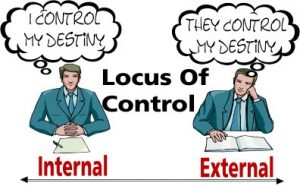
Locus of control is a relatively stable personality variable that represents the attribution a person makes about whether or not the effort they expend is contingent on their behavior. There are two extremes of the continuum: internal locus of control and external locus of control.

Internal locus of control occurs when an individual perceives that a specific reinforcing event is contingent on their own behavior. That is, the person perceives that what has happened externally is due to their behavior, and they have control over the external consequences. For example, a person with an internal locus of control attributes their happiness to themselves. If they want to be happy, they can work on it.

External locus of control occurs when an individual perceives that an external event has occurred independently of their behavior. Therefore, the individual associates the event with chance, luck, or destiny. For example, a person with an external locus of control attributes their happiness to another person or the situation.

Locus of Control and Personal Development

This concept is important because if a person believes that what happens around them is beyond their control, they may not act to change it. For example, if a person believes they have no control over the election of the political party that will govern their country, they may do nothing to change it, not even exercising their right to vote. On the other hand, if a person believes their vote will be important in the election of a new government, they may be motivated to change the political landscape and may even protest.

The feeling of not being able to control an event often creates a state of paralysis that prevents people from achieving their goals.

Internal locus of control is also an important aspect of personal development, as a person with an internal locus of control believes in their capabilities in the face of external events and knows that by putting in the best effort they will go far.

The literature presents a series of behavioral traits attributed to successful entrepreneurs, but one of the most important is Internal Locus of Control.

We have already seen the difference between internal locus of control and external locus of control, and that this implies that I, as a person, attribute my success and failure to my own actions, to my own initiatives. This is called internal locus of control, while external locus of control implies that I, as a person, attribute the results I have in life to luck, to fate, to other external factors, and to my actions.

So you can already imagine that a successful entrepreneur, a businessman, is a person with a high internal locus of control; a person who takes responsibility for their success and failure.

Other Characteristics of an Entrepreneur

Another characteristic that’s important to mention has to do with initiative. We say the world is full of good intentions, but truly, those who carry them out are those who can be called entrepreneurs. It’s like innovation: you can have many ideas and even inventions, but implementing them, getting the market to accept them, is only then innovation. So, implementing your ideas, getting the market to accept them, is what will truly define you as an entrepreneur.

Not everyone is qualified to be an entrepreneur; launching a project requires specific personal and professional characteristics. Being an entrepreneur also means having the motivation and financial means to succeed.

Generally speaking, in addition to the internal locus of control, an entrepreneur should possess the following qualities:

Creativity and innovation
Clarity of ideas
Ability to confront and assume risks
Ability to adapt to new situations
Knowing how to prioritize
Ability to communicate and socialize
Tenacity and persistence
Flexibility and ability to adapt to circumstances
Optimism

Mistaken Beliefs.

Believing that everything that happens to us is a product of chance, of others, of our destiny, of decisions we made in the past that we can no longer change; that we have to accept whatever happens to us or live frustrated, believing that the rest of the world is to blame for us not achieving our goals—these are mistakes that are as common as they are disastrous.

Being responsible for your decisions.

On the other hand, nothing is more mature and reassuring than a responsible person capable of taking responsibility for their actions and their consequences.

Someone capable of saying, «I was wrong,» «I’m sorry,» or, on the other hand, «I achieved this with great effort,» «I deserve this because I worked for it,» for example, is a person who conveys maturity, wisdom, and, very importantly, calm to others.

As a general rule, we tend to assume our successes as our own responsibility, but our failures as something that is the fault of others (remember the «I wasn’t lucky vs. I got it»?), although it is also very common to find people who, either due to a lack of self-esteem or because they confuse the concept of humility, never acknowledge or take credit for success, even if it is the result of many hours of work.

Have you ever wondered who is really responsible for your success?

In this video, we explore the concept of «locus of control» and how it influences entrepreneurship. You’ll learn the difference between internal and external locus of control through everyday examples and how this concept can be the key to transforming your life and business

Who determines your success? Discover the Locus of Control

Successful entrepreneurs take responsibility for their decisions and seek out opportunities, rather than waiting for luck to grace them. Are you ready to take control of your destiny?

Share this video if it’s inspired you and join the conversation about psychology and entrepreneurship.

Source:

From the course «Learning How to Learn,» by McMaster University & University of California, San Diego

Awaken your inner giant: take control of your life

Have you ever felt out of control, as if life is pulling you along with no clear direction? If so, you’re not alone. According to Tony Robbins in his powerful book Awaken the Giant Within , the key to transforming your life lies in your choices, not your circumstances. Robbins reminds us that we all have immense power within us, a «sleeping giant» waiting to be awakened through decisive actions, empowering beliefs, and conscious emotional states.

Robbins points out that every action begins with a decision. The problem isn’t a lack of knowledge, but a lack of commitment and focus. To improve our lives, we need to master our emotions, relationships, finances, and time. And to do so, the first step is deciding to change. It’s not about hope or luck, but about making concrete decisions, eliminating distractions, and committing to a clear outcome.

The power of pain and pleasure

A central idea in the book is that our decisions are influenced by the pursuit of pleasure and the avoidance of pain. Robbins proposes conditioning the mind to associate pleasure with good habits and pain with negative ones. This creates such powerful emotional associations that our behaviors begin to align with our goals.

This principle also applies to our beliefs: many of them stem from past experiences linked to pain or pleasure. Robbins explains that if we learn to reinterpret these experiences, we can change limiting beliefs that affect our perception of the present and our future decisions.

The process of real change

Through the Neuro-Associative Conditioning (NAC) method, Robbins offers a clear path to lasting change. The process involves identifying negative patterns, interrupting them, and replacing them with new habits reinforced with intense emotions and rewards. This method demonstrates that change doesn’t have to be slow: with the right strategy, it can be rapid and permanent.

Emotion, language and transformation

The emotions we feel daily determine our actions. Robbins emphasizes that to change our lives, we must learn to master our emotions, starting with changing our language. The words we use affect how we perceive our reality. Changing words like «failure» to «learning,» or «problem» to «challenge,» also transforms our way of acting.

The metaphors we use are equally powerful: if you say you’re «in a tunnel with no exit,» your mind will act as if it were real. Change that image to a «bend in the road» and you’ll see how your focus changes too.

Clear goals, positive thoughts

For Robbins, success lies in having clear goals and a defined plan to achieve them. Visualizing these goals every day reinforces our commitment and maintains motivation. However, it’s also vital to enjoy the journey, not just the destination.

Finally, Robbins proposes the «10 Days Without Negative Thoughts» challenge, a practice that seeks to reprogram the mind to focus only on constructive things. If you change your thoughts, you change your life.


Conclusion

The inner giant isn’t something we should seek outside; it already lives within us. It only takes a real, conscious, and focused decision to awaken it. By taking control of our emotions, beliefs, and thoughts, we also take control of our future.


Awaken your inner giant: take control of your life

Bibliography (APA format):

Robbins, A. (1991). Awaken the Giant Within: How to Take Control of Your Mental, Emotional, Physical, and Financial Destiny . Debolsillo Publishing.