

Creating Prototypes: The Business Model Canvas
Creating Prototypes: The Business Model Canvas
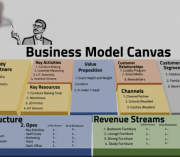
When creating a business model using the Business Model Canvas methodology, you can think of the business model as a story—a story of how your company will create, deliver, and capture value. And like any story, it might be one you’ve heard time and time again.
For example, you can start with what most people emphasize: the value proposition.
If it’s a trip for retirees, the next step is to decide who you can sell it to. It makes sense to define an ideal segment as baby boomers, since the Baby Boomer Generation (1946–1964) comprises people between 56 and 73 years old, characterized by being committed, self-sufficient, and competitive.
The next step is to outline how you will reach them, and yes, that could be through a website. Another point is to define how this will generate revenue, which would involve setting sales fees.
Another question to resolve is what key resources are needed to offer all of this and how we achieve a reliable website with brand recognition.
From this, it may emerge that the key activities will be marketing, the website, and its maintenance. And finally, the other big question is, where will the costs come from? What will sales, the development of the marketing platform, and all of this cost? By resolving all of the above, we could say that we have the first model. But this would only be a step forward.
Predictable models can work, but they rarely provide a competitive advantage. Therefore, one should not settle for a first idea. To compete in a world where the best model wins, one will have to think more and explore alternatives. For example, a prototype of a model where achieving the value proposition can be done at minimal cost or for free.
This will change everything instantly. This realistic model may not be found, but exploring it will force you to think hard about potential alternatives. As an entrepreneur, you must be thinking about the model in a 24/7 environment, that is, all the time. Now, you might think you already have a tool for structuring ideas into rapid prototypes to consider with your team, if needed.
By using this tool, and being optimistic, you could end up with a disruptive model that changes an entire industry, like Skype with its freemium model, or espresso, which became a multi-million dollar business by disrupting such a market and establishing itself as a coffee brewing technique.
In fact, understanding innovative, or simply successful, business models in other industries can be a great way to start achieving your own breakthrough. There’s no right or wrong way to do it, just three rules to get started.
First, focus on the business model. Not just your product, technology, or service.
Second, don’t fall in love with the first models. The best models are built on smart and unexpected elements, and that comes from creating many less obvious versions.
Which leads to the third rule. Interact by testing your models proactively and in a timely manner in the real world. How do you do that? That’s a topic for another time.
The important thing to consider is that if used correctly, Canvases can also serve as prototyping tools.
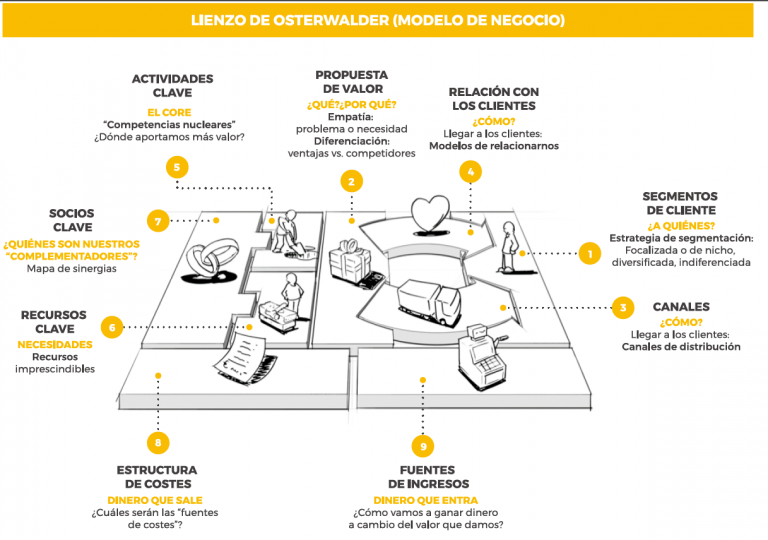
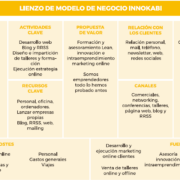
For inspiration, let’s look at the following example from Innokabi, where the canvas is used to develop the business model for their website:
Lean Canvas:
This canvas is based on Lean Startup methodologies. It’s an adaptation of Osterwalder’s model, but for entrepreneurs and innovators just starting out (not established companies). The right side represents the environment (market/society), while the left side represents the product/service.
This canvas uses a launch approach based on validation and scientific experimentation in an interactive way to shorten the processes of developing services/products, measuring progress, and obtaining feedback from target users. It’s best suited for developing services or entrepreneurial initiatives.
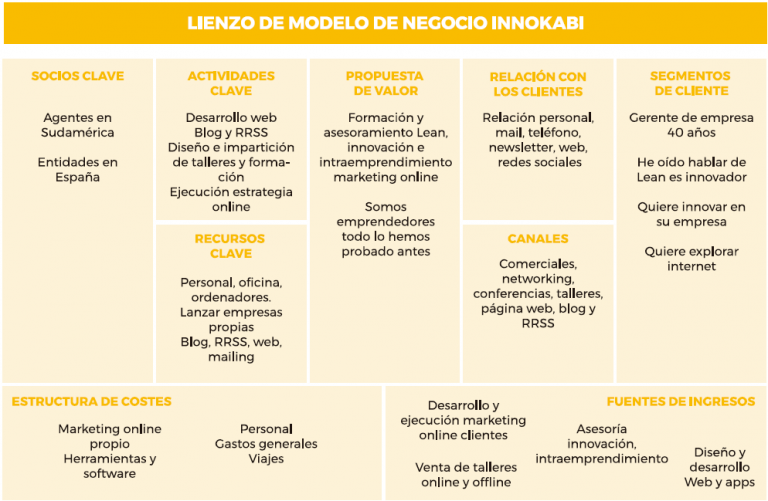
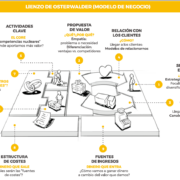
The following figure describes the different blocks of this canvas:
The use of these canvases as prototyping tools for innovation projects is valid and useful for the following reasons:
They serve as «templates» for working on projects collectively. They are very convenient tools for team reflection.
They are a very concise and powerful «visual narrative.» As you progress through them, they are excellent for explaining or communicating the critical aspects of the project.
They help you think in a structured way. They consist of «thinking boxes» that help the team not miss anything important.
They allow you to set the boundaries of the project (product or service) and mitigate the temptation to over-specify it by emphasizing the value perceived by users or beneficiary groups.
Remember that for a project to be viable, it needs proper management of its financial sustainability.
Crazy ideas like Airbnb, Uber, or Snapchat require more than incredible engineering knowledge. Therefore, prototyping crazy ideas can help us succeed, especially in a world where uncertainty reigns.


Dejar un comentario
¿Quieres unirte a la conversación?Siéntete libre de contribuir!