
Listado de la etiqueta: Canvas model
How Will Customers Find You and Stay With You? Mastering Channels and Customer Relationships in the Business Model Canvas
/0 Comentarios/en Finanzas/por JORGE MONTES DE OCAIntroduction
Many businesses fail not because their product is bad, but because customers never discover it—or they buy once and never return. This can be painful for entrepreneurs who invest time, money, and hope into something meaningful.
A great idea needs more than quality. It needs visibility, trust, and connection. That is why two of the most powerful parts of the Business Model Canvas are Channels and Customer Relationships.
These blocks help answer practical questions: How will people find us? How will we serve them? Why will they come back? They also push founders to observe the world around them: What regulations are coming? How is society changing? Who are our competitors, and what are they doing well?
When understood correctly, these blocks turn a business into a living relationship with the market.
## 1. Channels: How Your Value Reaches the Customer
Channels are the ways a company communicates with customers and delivers its value proposition. Even the best product can struggle if the wrong channel is used.
Common channels include:
- Website or online store
- Social media
- Email marketing
- Retail stores
- Distributors
- Mobile apps
- Events and networking
- Partnerships and affiliates
Good channels perform five tasks:
- Create awareness
- Help customers evaluate your offer
- Make purchasing easy
- Deliver the product or service
- Provide after-sales support
For example:
- A handmade brand may grow through Instagram and marketplaces.
- A consulting firm may rely on LinkedIn and referrals.
- A food business may need delivery apps and local presence.
The goal is not to be everywhere. It is to be where your customers already are.
## 2. Customer Relationships: Why They Return and Recommend You
Customer relationships define how you interact with people before, during, and after the sale.
Types of relationships include:
- Personal assistance
- Self-service
- Automated service
- Communities
- Membership programs
- Dedicated account management
- Co-creation (customers help improve products)
Strong relationships build loyalty, reduce marketing costs, and create trust.
Ask yourself:
- How quickly do we respond?
- Do customers feel heard?
- Is buying simple and pleasant?
- Do we stay connected after purchase?
A first sale creates income. A second sale creates stability.
In many industries, kindness and consistency are competitive advantages.
## 3. What Regulations Are Coming? How Is Society Changing?
Smart entrepreneurs do not only study customers—they study the future.
Regulations and social trends influence channels and relationships more each year. Depending on the country and industry, common changes include:
Emerging Regulations
- Data privacy rules
- Consumer transparency requirements
- Digital invoicing and tax compliance
- Sustainability reporting
- Accessibility standards for websites and services
Social Changes
- Customers expect faster responses
- More people prefer online purchasing
- Trust in reviews and communities is growing
- Buyers value ethical and sustainable brands
- Personalization is becoming normal
So when someone asks, “What regulations are coming? How is this society changing, Carl?” the real lesson is this:
Businesses must stay curious, adaptable, and informed.
Companies that listen early adjust faster.
## 4. Who Are Your Competitors? What Advantages Do They Have?
Competitors are not enemies—they are teachers.
Study three things:
Their Channels
Where do they attract attention? Social media? Stores? Partnerships?
Their Relationships
Do they offer faster service, stronger communities, subscriptions, loyalty rewards?
Their Business Model Advantages
- Lower costs
- Better convenience
- Stronger brand recognition
- Better technology
- Better customer experience
- Faster delivery
- More trust
Then ask:
- What do they do well?
- Where are customers still frustrated?
- How can we be different instead of copying?
Success often comes not from being bigger—but from being more relevant.
Conclusion
Channels and Customer Relationships remind us that businesses grow through connection, not only transactions.
Your product may be excellent—but if people cannot find you, trust you, or remember you, growth becomes difficult.
Ask yourself today:
Where will customers meet us? How will they feel when they do?
That answer can transform a startup into a brand people choose again and again.
Bibliography (APA)
Blank, S., & Dorf, B. (2020). The startup owner’s manual. K&S Ranch.
Osterwalder, A., & Pigneur, Y. (2010). Business model generation. Wiley.
Ries, E. (2011). The lean startup. Crown Business.
Kotler, P., & Keller, K. (2016). Marketing management (15th ed.). Pearson.
Cap 5 Canvas - Proving It
What Will Customers Happily Pay For? Mastering Revenue Streams and Key Resources in the Business Model Canvas
/0 Comentarios/en Finanzas/por JORGE MONTES DE OCAIntroduction
Many people start a business with passion, talent, and a dream—but dreams alone do not pay suppliers, salaries, or rent. A strong business idea becomes sustainable when it clearly answers two essential questions: How will money come in? and What do we need to deliver value consistently?
This is where the Business Model Canvas becomes powerful. It helps entrepreneurs organize ideas into a practical model. In this article, we focus on two vital areas: Revenue Streams (how the business earns money) and Key Resources (what the business needs to operate and grow).
When these two pieces are clear, a business gains direction, confidence, and the ability to grow with purpose.
## 1. Revenue Streams: What Are Customers Willing to Pay For?
Revenue streams represent the money a company receives from each customer segment. But the real question is deeper:
What problem is valuable enough for customers to spend money solving?
Customers usually pay for one or more of these forms of value:
- Convenience – saving time or effort
- Quality – reliability, durability, excellence
- Status – image, prestige, identity
- Savings – lower cost over time
- Security – trust, guarantees, peace of mind
- Experience – enjoyment, comfort, emotion
- Results – measurable transformation
For example:
- A busy parent pays for meal delivery because it saves time.
- A company pays premium software because it improves efficiency.
- A student pays for coaching because it increases confidence and results.
The lesson is simple: customers do not buy products—they buy outcomes.
## 2. How to Determine Your Pricing Strategy
Pricing is emotional and strategic. Charging too little may create distrust or losses. Charging too much without value creates resistance.
Here are practical pricing techniques:
Cost-Plus Pricing
Calculate total costs and add a profit margin.
Best for: physical products, simple operations.
Value-Based Pricing
Price according to the value perceived by the customer.
Best for: consulting, premium brands, specialized services.
Competitor-Based Pricing
Compare similar market offers and position yourself lower, equal, or higher.
Best for: competitive industries.
Tiered Pricing
Offer multiple levels (Basic, Pro, Premium).
Best for: software, memberships, coaching.
Test and Learn
Launch with one price, collect feedback, and improve.
Best for: startups.
Questions to Ask Before Setting a Price
- What problem am I solving?
- How urgent is that problem?
- What alternatives exist?
- How much money or time do I save the customer?
- What experience am I creating?
Good pricing respects both the customer and the business.
## 3. Key Resources: What Do You Need to Deliver Value?
Key resources are the assets required to create and deliver your value proposition.
These usually fall into four categories:
Physical Resources
Equipment, office, inventory, vehicles, tools, technology.
Intellectual Resources
Brand, know-how, systems, patents, content, customer data.
Human Resources
Founders, employees, freelancers, advisors, customer service.
Financial Resources
Cash flow, savings, investors, credit lines.
Example:
An online fitness coach may need:
- Laptop and camera
- Coaching methodology
- Social media presence
- Scheduling software
- Energy, discipline, communication skills
- Startup capital
The key is not owning everything. It is knowing what is essential.
## 4. Why This Matters for Success, Confidence, and Happiness
Many entrepreneurs feel stress because they are working hard without clarity. A business model reduces uncertainty.
When you understand:
- who pays,
- why they pay,
- how much they pay,
- and what you need to serve them,
you make better decisions and avoid wasting energy.
This also supports personal growth. You become more disciplined, strategic, and resilient. A business built with intention can create income—but also freedom, meaning, and pride.
Success is not only revenue. It is building something useful and sustainable.
Conclusion
The Business Model Canvas reminds us that a business is more than an idea—it is a system of value. Revenue streams show how trust becomes income. Key resources show what must be protected, developed, and strengthened.
If you are starting a business, ask yourself today:
What value will people gladly pay for—and what do I truly need to deliver it well?
The clearer your answer, the stronger your future becomes.
Bibliography (APA)
Blank, S., & Dorf, B. (2020). The startup owner’s manual. K&S Ranch.
Osterwalder, A., & Pigneur, Y. (2010). Business model generation. Wiley.
Ries, E. (2011). The lean startup. Crown Business.
Kotler, P., & Keller, K. (2016). Marketing management (15th ed.). Pearson.
Cap 4 Canvas - Navegando en tu entorno
Creating Prototypes: The Business Model Canvas
/0 Comentarios/en Finanzas/por JORGE MONTES DE OCACreating Prototypes: The Business Model Canvas
When creating a business model using the Business Model Canvas methodology, you can think of the business model as a story—a story of how your company will create, deliver, and capture value. And like any story, it might be one you’ve heard time and time again.
For example, you can start with what most people emphasize: the value proposition.
If it’s a trip for retirees, the next step is to decide who you can sell it to. It makes sense to define an ideal segment as baby boomers, since the Baby Boomer Generation (1946–1964) comprises people between 56 and 73 years old, characterized by being committed, self-sufficient, and competitive.
The next step is to outline how you will reach them, and yes, that could be through a website. Another point is to define how this will generate revenue, which would involve setting sales fees.
Another question to resolve is what key resources are needed to offer all of this and how we achieve a reliable website with brand recognition.
From this, it may emerge that the key activities will be marketing, the website, and its maintenance. And finally, the other big question is, where will the costs come from? What will sales, the development of the marketing platform, and all of this cost? By resolving all of the above, we could say that we have the first model. But this would only be a step forward.
Predictable models can work, but they rarely provide a competitive advantage. Therefore, one should not settle for a first idea. To compete in a world where the best model wins, one will have to think more and explore alternatives. For example, a prototype of a model where achieving the value proposition can be done at minimal cost or for free.
This will change everything instantly. This realistic model may not be found, but exploring it will force you to think hard about potential alternatives. As an entrepreneur, you must be thinking about the model in a 24/7 environment, that is, all the time. Now, you might think you already have a tool for structuring ideas into rapid prototypes to consider with your team, if needed.
By using this tool, and being optimistic, you could end up with a disruptive model that changes an entire industry, like Skype with its freemium model, or espresso, which became a multi-million dollar business by disrupting such a market and establishing itself as a coffee brewing technique.
In fact, understanding innovative, or simply successful, business models in other industries can be a great way to start achieving your own breakthrough. There’s no right or wrong way to do it, just three rules to get started.
First, focus on the business model. Not just your product, technology, or service.
Second, don’t fall in love with the first models. The best models are built on smart and unexpected elements, and that comes from creating many less obvious versions.
Which leads to the third rule. Interact by testing your models proactively and in a timely manner in the real world. How do you do that? That’s a topic for another time.
The important thing to consider is that if used correctly, Canvases can also serve as prototyping tools.
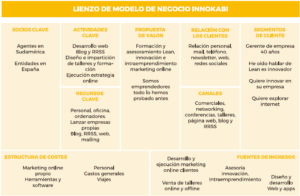
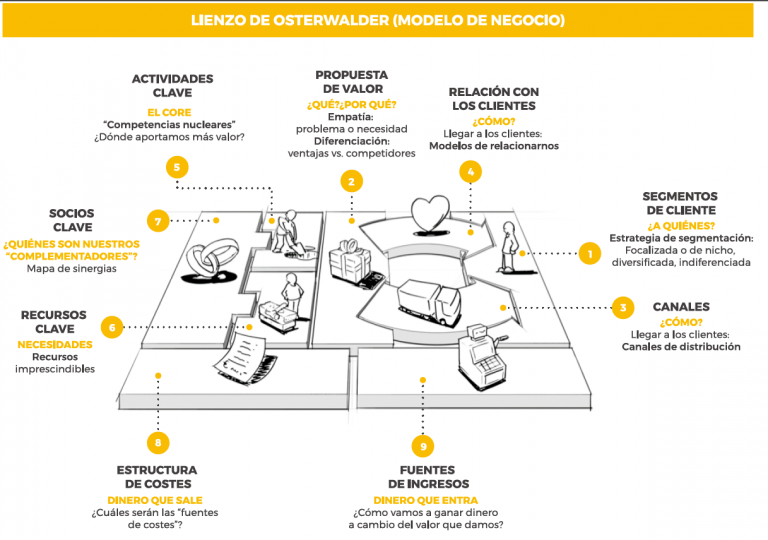
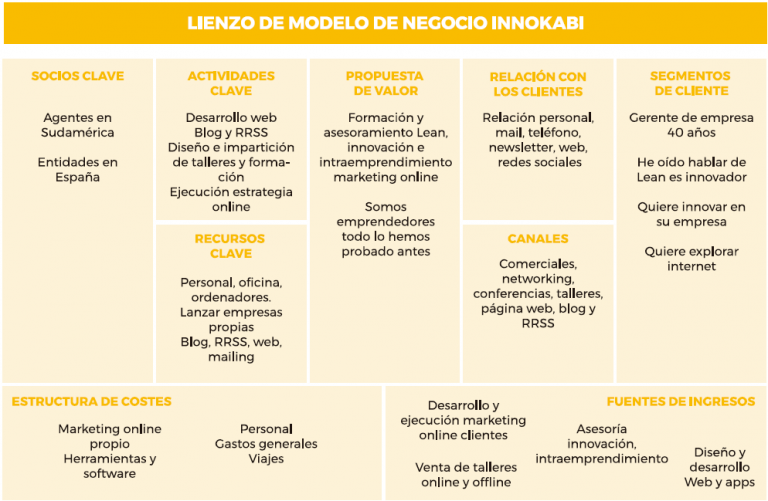
For inspiration, let’s look at the following example from Innokabi, where the canvas is used to develop the business model for their website:
Lean Canvas:
This canvas is based on Lean Startup methodologies. It’s an adaptation of Osterwalder’s model, but for entrepreneurs and innovators just starting out (not established companies). The right side represents the environment (market/society), while the left side represents the product/service.
This canvas uses a launch approach based on validation and scientific experimentation in an interactive way to shorten the processes of developing services/products, measuring progress, and obtaining feedback from target users. It’s best suited for developing services or entrepreneurial initiatives.
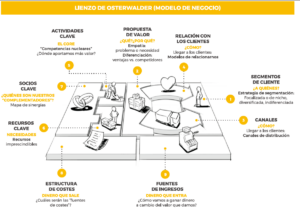
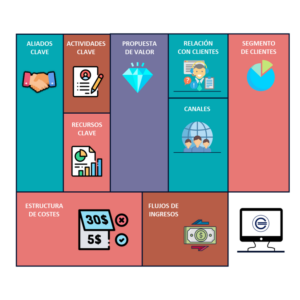
The following figure describes the different blocks of this canvas:
The use of these canvases as prototyping tools for innovation projects is valid and useful for the following reasons:
They serve as «templates» for working on projects collectively. They are very convenient tools for team reflection.
They are a very concise and powerful «visual narrative.» As you progress through them, they are excellent for explaining or communicating the critical aspects of the project.
They help you think in a structured way. They consist of «thinking boxes» that help the team not miss anything important.
They allow you to set the boundaries of the project (product or service) and mitigate the temptation to over-specify it by emphasizing the value perceived by users or beneficiary groups.
Remember that for a project to be viable, it needs proper management of its financial sustainability.
Crazy ideas like Airbnb, Uber, or Snapchat require more than incredible engineering knowledge. Therefore, prototyping crazy ideas can help us succeed, especially in a world where uncertainty reigns.
Bibliografia aqui
Cap 3 Canvas - Creacion de Prototipos

What Will Customers Happily Pay For? Mastering Revenue Streams and Key Resources in the Business Model Canvas

The Business Model Canvas: Turning Ideas into Real Businesses

Visualizing Your Business Model – The Business Model Canvas
/0 Comentarios/en Finanzas/por JORGE MONTES DE OCAEl modelo Canvas te permite concentrarte en tu modelo de negocio segmento por segmento.
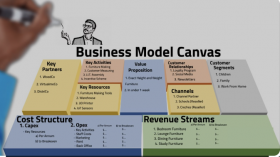
The 9 Elements of the Business Model Canvas.
The starting point for a good discussion about developing a business model is having a shared understanding of what a business model is.
Alex Osterwalder and Yves Pigneur, authors of the best-selling book «Business Model Generation,» define a business model as «the reason why an organization creates, delivers, and captures value.» So, to reiterate, a business model is the reason why an organization creates, delivers, and captures value.
Alex and Yves believe that a business model can be best described through nine basic building blocks, which illustrate the logic of how a company intends to acquire customers and generate revenue. This is why they invented the Business Model Canvas.
1. Customer Segments.
For building block 1, the business model experts at Cavas recommend starting with customer segments. So we’ll need to identify and define our customer segments. Typically, there are between five and seven segments.
2. Value Proposition.
In building block number 2, value propositions, we must determine what value we can create to deliver what will be most important to our chosen customer segment.
How compelling is your value proposition? Why do your customers consume your product? Why do they buy it?
The value proposition is the core of a company’s reason for being and is how you satisfy customer needs.
3. Channels.
In block 3, the question is which channels we will use, and for this, we need to determine how we will communicate and deliver the value propositions to our customer segment.
How are your products or services promoted, sold, and delivered? Why? Are they working?
4. Customer Relationships.
In Block 4, Customer Relationships, we must critically identify how we can build better, more authentic relationships with customers and strategic partners that lead to deep trust and loyalty.
How do you interact with the customer throughout their journey?
5. Revenue Streams.
Block 5, Revenue Streams, focuses on capturing the value we create and deliver. How do we generate a reasonable amount of revenue for our efforts?
How does your value proposition generate revenue?
6. Key Resources.
Block 6, Key Resources, focuses on the assets we need to deliver our value propositions. Key resources are typically divided into four categories: physical, human, intellectual, and financial.
What unique strategic assets does my business possess to compete?
7. Key Activities.
Next, in Block 7, are the key activities, which are the most important actions the company takes to operate successfully. Activities typically include operations, production, sales and marketing, and financial management.
What unique strategies does your business have for delivering its value proposition to the customer?
8. Key Partnerships.
Section 8 comprises Key Partnerships, which are very important and, in many ways, have become the cornerstone of most business models. Alliances typically include strategic alliances between non-competing companies, joint ventures, or, more recently, the co-creation of value with customers.
What activities can the company discontinue to focus on its key activities?
Creating alliances with partners is important for both startups and established organizations.
9. Cost Structure.
Finally, section 9, but certainly not least, is the cost structure. For this, we will need to identify all the costs involved in creating and delivering the customer value proposition that we promise in our business model.
What are the company’s main cost drivers? How do they relate to revenue?
By understanding your cost structure, you’ll know the minimum sales volume required to generate a profit. The cost structure considers economies of scale, fixed costs, variable costs, and profit.
The Starbucks Business Model Canvas, for example, places particular emphasis on different activities related to the company’s performance over the years. As we can see, expansion into new markets is ranked first among the key activities, while the coffee experience is recognized as the primary aspect of the value proposition.
Coca-Cola, on the other hand, focuses much of its Business Model Canvas on product distribution and the…
Bibliografia:
Sistema Universitario de Georgia. (sf). Del curso; «Model Business Canvas: una herramienta para emprendedores e innovadores»
Visualizing Your Business Model – The Business Model Canvas

What Will Customers Happily Pay For? Mastering Revenue Streams and Key Resources in the Business Model Canvas

How Will Customers Find You and Stay With You? Mastering Channels and Customer Relationships in the Business Model Canvas

From Idea to Business Model – The Business Model Canvas
/0 Comentarios/en Finanzas/por JORGE MONTES DE OCAAre you interested in starting your own business? Are you an entrepreneur looking to accelerate profitable growth by improving your business model? Are you an intrapreneur within an organization with a new idea that could make your customers smile and your competitors cry?
If so, the Business Model Canvas is the best place to start. It’s a proven tool for creating, evaluating, or reinventing a business model.
According to some estimates, 8 out of 10 businesses fail within the first two years due to flawed business planning. However, there are support tools available to change that. The Business Model Canvas allows you to focus on your business model segment by segment.
What is the Business Model Canvas?
It’s a strategic management tool that allows you to understand the key aspects of your business: how they relate to and compensate for each other. It makes your organization’s infrastructure, value proposition, customers, and financial situation visible so you can identify weaknesses and analyze performance.
It was developed by business consultant Alexander Osterwalder and information systems and management professor Yves Pigneur. They defined nine categories for the model, representing the basic components of an organization.
Importance of the Canvas Model
The Canvas model is an ideal tool for understanding a business model in a more direct and structured way. Using it will help you visualize your customer information, the value propositions you offer, the channels through which you sell, and how your company makes money. Furthermore, you can use the Canvas model not only to understand your own business model but also that of your competitors.
Likewise, it’s a tool that allows you to have a global view of your business, which will facilitate innovation to adapt to market changes. It not only helps you understand who your customers and products are but also ensures that all members of your organization share the same focus.
As a qualitative tool, it should be complemented with quantitative models such as data and numerical analysis, as well as financial, accounting, marketing, and other tools.
Once the Canvas model is structured, it can shape your company, generate new ideas for implementation, and innovate for all the changes you want and need.
What is the Canvas model used for?
The Canvas model is used to identify the essential aspects of a business model, presenting them in a structured way so that you can find relevant activities, areas for improvement, potential alternatives to the existing model, and more.
Let’s look in more detail at what the Canvas model is used for:
1. It allows you to identify the essentials
With the Canvas model, you have an overview of what your business model really is. It also shows which activities are not as relevant or even which ones get in the way of achieving your goals. It focuses your vision on the essentials, and in this way, you can optimize your business model.
2. It provides a foundation for brainstorming
The Canvas model is the perfect starting point to let your ideas and those of your team flow freely. You can also test alternative models to complement your business idea and find new marketing possibilities.
3. It provides a structured presentation
The Canvas model presents your business in a clear and structured way, using a general and visual approach. This allows others to quickly understand and discuss your business model, and ensures that all areas of your project receive the information that is important to them and to the company.
4. It lays the foundation for your business plans
The Canvas model doesn’t replace a detailed business plan, but it provides a framework that will serve as the skeleton of your business plan.
Bibliografia:
Sistema Universitario de Georgia. (sf). Del curso; «Model Business Canvas: una herramienta para emprendedores e innovadores»
Cap 1 Canvas - De la idea al Modelo de Negocio

From Idea to Business Model – The Business Model Canvas

Visualizing Your Business Model – The Business Model Canvas