Are you interested in starting your own business? Are you an entrepreneur looking to accelerate profitable growth by improving your business model? Are you an intrapreneur within an organization with a new idea that could make your customers smile and your competitors cry?
If so, the Business Model Canvas is the best place to start. It’s a proven tool for creating, evaluating, or reinventing a business model.
According to some estimates, 8 out of 10 businesses fail within the first two years due to flawed business planning. However, there are support tools available to change that. The Business Model Canvas allows you to focus on your business model segment by segment.
What is the Business Model Canvas?
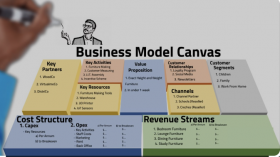
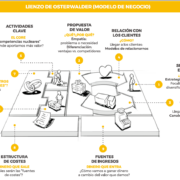
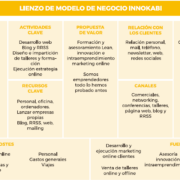
It’s a strategic management tool that allows you to understand the key aspects of your business: how they relate to and compensate for each other. It makes your organization’s infrastructure, value proposition, customers, and financial situation visible so you can identify weaknesses and analyze performance.
It was developed by business consultant Alexander Osterwalder and information systems and management professor Yves Pigneur. They defined nine categories for the model, representing the basic components of an organization.
Importance of the Canvas Model
The Canvas model is an ideal tool for understanding a business model in a more direct and structured way. Using it will help you visualize your customer information, the value propositions you offer, the channels through which you sell, and how your company makes money. Furthermore, you can use the Canvas model not only to understand your own business model but also that of your competitors.
Likewise, it’s a tool that allows you to have a global view of your business, which will facilitate innovation to adapt to market changes. It not only helps you understand who your customers and products are but also ensures that all members of your organization share the same focus.
As a qualitative tool, it should be complemented with quantitative models such as data and numerical analysis, as well as financial, accounting, marketing, and other tools.
Once the Canvas model is structured, it can shape your company, generate new ideas for implementation, and innovate for all the changes you want and need.
What is the Canvas model used for?
The Canvas model is used to identify the essential aspects of a business model, presenting them in a structured way so that you can find relevant activities, areas for improvement, potential alternatives to the existing model, and more.
Let’s look in more detail at what the Canvas model is used for:
1. It allows you to identify the essentials
With the Canvas model, you have an overview of what your business model really is. It also shows which activities are not as relevant or even which ones get in the way of achieving your goals. It focuses your vision on the essentials, and in this way, you can optimize your business model.
2. It provides a foundation for brainstorming
The Canvas model is the perfect starting point to let your ideas and those of your team flow freely. You can also test alternative models to complement your business idea and find new marketing possibilities.
3. It provides a structured presentation
The Canvas model presents your business in a clear and structured way, using a general and visual approach. This allows others to quickly understand and discuss your business model, and ensures that all areas of your project receive the information that is important to them and to the company.
4. It lays the foundation for your business plans
The Canvas model doesn’t replace a detailed business plan, but it provides a framework that will serve as the skeleton of your business plan.


 The Power of Assertive Behavior: A Key to Conscious Leadership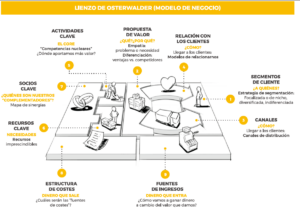


Dejar un comentario
¿Quieres unirte a la conversación?Siéntete libre de contribuir!