El modelo Canvas te permite concentrarte en tu modelo de negocio segmento por segmento.
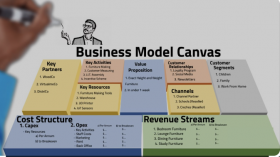
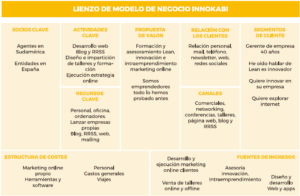
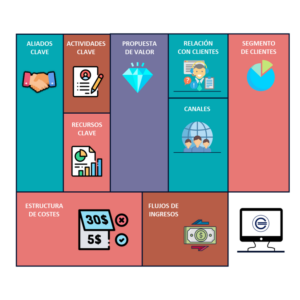
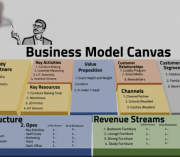
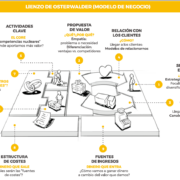
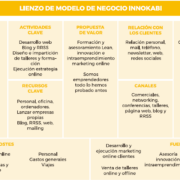
The 9 Elements of the Business Model Canvas.
The starting point for a good discussion about developing a business model is having a shared understanding of what a business model is.
Alex Osterwalder and Yves Pigneur, authors of the best-selling book «Business Model Generation,» define a business model as «the reason why an organization creates, delivers, and captures value.» So, to reiterate, a business model is the reason why an organization creates, delivers, and captures value.
Alex and Yves believe that a business model can be best described through nine basic building blocks, which illustrate the logic of how a company intends to acquire customers and generate revenue. This is why they invented the Business Model Canvas.
1. Customer Segments.
For building block 1, the business model experts at Cavas recommend starting with customer segments. So we’ll need to identify and define our customer segments. Typically, there are between five and seven segments.
2. Value Proposition.
In building block number 2, value propositions, we must determine what value we can create to deliver what will be most important to our chosen customer segment.
How compelling is your value proposition? Why do your customers consume your product? Why do they buy it?
The value proposition is the core of a company’s reason for being and is how you satisfy customer needs.
3. Channels.
In block 3, the question is which channels we will use, and for this, we need to determine how we will communicate and deliver the value propositions to our customer segment.
How are your products or services promoted, sold, and delivered? Why? Are they working?
4. Customer Relationships.
In Block 4, Customer Relationships, we must critically identify how we can build better, more authentic relationships with customers and strategic partners that lead to deep trust and loyalty.
How do you interact with the customer throughout their journey?
5. Revenue Streams.
Block 5, Revenue Streams, focuses on capturing the value we create and deliver. How do we generate a reasonable amount of revenue for our efforts?
How does your value proposition generate revenue?
6. Key Resources.
Block 6, Key Resources, focuses on the assets we need to deliver our value propositions. Key resources are typically divided into four categories: physical, human, intellectual, and financial.
What unique strategic assets does my business possess to compete?
7. Key Activities.
Next, in Block 7, are the key activities, which are the most important actions the company takes to operate successfully. Activities typically include operations, production, sales and marketing, and financial management.
What unique strategies does your business have for delivering its value proposition to the customer?
8. Key Partnerships.
Section 8 comprises Key Partnerships, which are very important and, in many ways, have become the cornerstone of most business models. Alliances typically include strategic alliances between non-competing companies, joint ventures, or, more recently, the co-creation of value with customers.
What activities can the company discontinue to focus on its key activities?
Creating alliances with partners is important for both startups and established organizations.
9. Cost Structure.
Finally, section 9, but certainly not least, is the cost structure. For this, we will need to identify all the costs involved in creating and delivering the customer value proposition that we promise in our business model.
What are the company’s main cost drivers? How do they relate to revenue?
By understanding your cost structure, you’ll know the minimum sales volume required to generate a profit. The cost structure considers economies of scale, fixed costs, variable costs, and profit.
The Starbucks Business Model Canvas, for example, places particular emphasis on different activities related to the company’s performance over the years. As we can see, expansion into new markets is ranked first among the key activities, while the coffee experience is recognized as the primary aspect of the value proposition.
Coca-Cola, on the other hand, focuses much of its Business Model Canvas on product distribution and the…


 Don’t Break the Chain: The Simple Path to Lasting Habits

Dejar un comentario
¿Quieres unirte a la conversación?Siéntete libre de contribuir!