Listado de la etiqueta: healt

Learn to Analyze Your Business Figures

Understanding your business’s financial figures is not only a good practice, but a necessity to ensure its sustainability, growth, and profitability. One of the most common mistakes in small and medium-sized businesses is making decisions based on incorrect perceptions or assumptions, often due to a lack of understanding of basic concepts such as Gross Profit Margin (GPM) . This metric is critical because it represents the direct profitability of the products or services sold, before considering operating expenses, taxes, and other indirect costs.

Gross profit margin is the difference between sales revenue and the cost of goods sold (COGS). This margin is generally expressed as a percentage of total sales. In other words, it tells us how much of each peso sold remains as gross profit, allowing us to assess the efficiency with which resources are being used for production and sales.

Practical example:

Let’s say you buy a television for 1,000 pesos and sell it for 1,300 pesos. The difference between the selling price and the acquisition cost is 300 pesos. At first glance, the profit margin may appear to be 30%, but this calculation is incorrect if based on cost. To obtain the correct MUB, the calculation must be based on the selling price:

MUB (%) = (Profit / Selling Price) x 100 = (300 / 1300) x 100 = 23.08%

This example demonstrates how many entrepreneurs overestimate their profits, believing they are earning more than they actually are. This overestimation can lead to inappropriate pricing strategies, underestimated operating costs, or misallocated resources, creating financial imbalances.

Importance of MUB in business management

Knowing the gross profit margin allows you to:

  • Have a clear vision of the profitability of each product or service.
  • Set appropriate prices.
  • Detect opportunities for improvement in the supply chain or cost structure.
  • Make informed decisions about investment, savings, and growth.
  • Make more accurate financial projections.

It’s important to clarify that this analysis should be performed without considering taxes, discounts, returns, or other indirect expenses, as the MUB focuses on the relationship between sales and direct costs. Once the MUB is known, we can move on to the net income analysis, which already considers all expenses and taxes, allowing for a comprehensive evaluation of the business.

Therefore, mastering this type of analysis not only gives you control, but also provides tools to navigate intelligently in today’s competitive environment, where every percentage point of profit counts.

I hope I’ve encouraged you to review your company’s numbers and, accordingly, keep your quarterly planning within realistic parameters. If you have any questions, please don’t hesitate to contact us. We look forward to hearing from you!

We also invite you to review our article “Practical tips to improve your financial situation – Personal budget” , where you will have an approach to personal finances and thus you can learn to make more assertive decisions for your family and business.

Wealth for Everyone: Secrets of Financial Success

Bibliography (APA format):

  • Gitman, L.J., & Zutter, C.J. (2015). Principles of Financial Management (14th ed.). Pearson Education.
  • Horngren, CT, Sundem, GL, & Stratton, WO (2014). Management accounting (14th ed.). Pearson Education.
  • Brigham, E.F., & Houston, J.F. (2019). Fundamentals of Financial Management (15th ed.). Cengage Learning .
  • Ross, S.A., Westerfield , RW, & Jordan, B.D. (2016). Fundamentals of corporate finance (11th ed.). McGraw-Hill Education .
  • Saldaña, MJ (2021). Financial Analysis for Entrepreneurs: How to Understand Your Business’s Numbers . Emprende Fácil Publishing House.

Locus of Control and Entrepreneurship: Whose Success Depends?

Have you heard of locus of control and its influence on personality?

According to psychologist Rotter, locus of control is a widely used topic in psychology and affects an individual’s perspective and the way they interact with their environment. Rotter, in 1966, proposed «locus of control» as a personality trait in his Social Learning Theory.

«If the person perceives the event as contingent on their behavior or their own relatively permanent characteristics, this has been called a belief in internal control.» Conversely, «when a reinforcement is perceived as following some personal action, but not being entirely contingent on it, it is typically perceived, in our culture, as the result of luck, and in this sense, it has been called a belief in external control.»

—Rotter, 1966

What is locus of control?

According to Rotter’s Social Learning Theory, which preceded Albert Bandura’s, human behavior occurs through a continuous interaction between cognitive, behavioral, and environmental determinants. Therefore, a person’s perception of control or lack of control over the events that occur around them is important for the course of their own life.

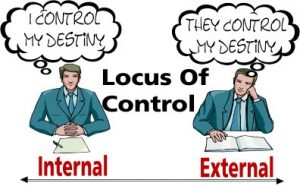
Locus of control is a relatively stable personality variable that represents the attribution a person makes about whether or not the effort they expend is contingent on their behavior. There are two extremes of the continuum: internal locus of control and external locus of control.

Internal locus of control occurs when an individual perceives that a specific reinforcing event is contingent on their own behavior. That is, the person perceives that what has happened externally is due to their behavior, and they have control over the external consequences. For example, a person with an internal locus of control attributes their happiness to themselves. If they want to be happy, they can work on it.

External locus of control occurs when an individual perceives that an external event has occurred independently of their behavior. Therefore, the individual associates the event with chance, luck, or destiny. For example, a person with an external locus of control attributes their happiness to another person or the situation.

Locus of Control and Personal Development

This concept is important because if a person believes that what happens around them is beyond their control, they may not act to change it. For example, if a person believes they have no control over the election of the political party that will govern their country, they may do nothing to change it, not even exercising their right to vote. On the other hand, if a person believes their vote will be important in the election of a new government, they may be motivated to change the political landscape and may even protest.

The feeling of not being able to control an event often creates a state of paralysis that prevents people from achieving their goals.

Internal locus of control is also an important aspect of personal development, as a person with an internal locus of control believes in their capabilities in the face of external events and knows that by putting in the best effort they will go far.

The literature presents a series of behavioral traits attributed to successful entrepreneurs, but one of the most important is Internal Locus of Control.

We have already seen the difference between internal locus of control and external locus of control, and that this implies that I, as a person, attribute my success and failure to my own actions, to my own initiatives. This is called internal locus of control, while external locus of control implies that I, as a person, attribute the results I have in life to luck, to fate, to other external factors, and to my actions.

So you can already imagine that a successful entrepreneur, a businessman, is a person with a high internal locus of control; a person who takes responsibility for their success and failure.

Other Characteristics of an Entrepreneur

Another characteristic that’s important to mention has to do with initiative. We say the world is full of good intentions, but truly, those who carry them out are those who can be called entrepreneurs. It’s like innovation: you can have many ideas and even inventions, but implementing them, getting the market to accept them, is only then innovation. So, implementing your ideas, getting the market to accept them, is what will truly define you as an entrepreneur.

Not everyone is qualified to be an entrepreneur; launching a project requires specific personal and professional characteristics. Being an entrepreneur also means having the motivation and financial means to succeed.

Generally speaking, in addition to the internal locus of control, an entrepreneur should possess the following qualities:

Creativity and innovation
Clarity of ideas
Ability to confront and assume risks
Ability to adapt to new situations
Knowing how to prioritize
Ability to communicate and socialize
Tenacity and persistence
Flexibility and ability to adapt to circumstances
Optimism

Mistaken Beliefs.

Believing that everything that happens to us is a product of chance, of others, of our destiny, of decisions we made in the past that we can no longer change; that we have to accept whatever happens to us or live frustrated, believing that the rest of the world is to blame for us not achieving our goals—these are mistakes that are as common as they are disastrous.

Being responsible for your decisions.

On the other hand, nothing is more mature and reassuring than a responsible person capable of taking responsibility for their actions and their consequences.

Someone capable of saying, «I was wrong,» «I’m sorry,» or, on the other hand, «I achieved this with great effort,» «I deserve this because I worked for it,» for example, is a person who conveys maturity, wisdom, and, very importantly, calm to others.

As a general rule, we tend to assume our successes as our own responsibility, but our failures as something that is the fault of others (remember the «I wasn’t lucky vs. I got it»?), although it is also very common to find people who, either due to a lack of self-esteem or because they confuse the concept of humility, never acknowledge or take credit for success, even if it is the result of many hours of work.

Have you ever wondered who is really responsible for your success?

In this video, we explore the concept of «locus of control» and how it influences entrepreneurship. You’ll learn the difference between internal and external locus of control through everyday examples and how this concept can be the key to transforming your life and business

Who determines your success? Discover the Locus of Control

Successful entrepreneurs take responsibility for their decisions and seek out opportunities, rather than waiting for luck to grace them. Are you ready to take control of your destiny?

Share this video if it’s inspired you and join the conversation about psychology and entrepreneurship.

Source:

From the course «Learning How to Learn,» by McMaster University & University of California, San Diego

Awaken your inner giant: take control of your life

Have you ever felt out of control, as if life is pulling you along with no clear direction? If so, you’re not alone. According to Tony Robbins in his powerful book Awaken the Giant Within , the key to transforming your life lies in your choices, not your circumstances. Robbins reminds us that we all have immense power within us, a «sleeping giant» waiting to be awakened through decisive actions, empowering beliefs, and conscious emotional states.

Robbins points out that every action begins with a decision. The problem isn’t a lack of knowledge, but a lack of commitment and focus. To improve our lives, we need to master our emotions, relationships, finances, and time. And to do so, the first step is deciding to change. It’s not about hope or luck, but about making concrete decisions, eliminating distractions, and committing to a clear outcome.

The power of pain and pleasure

A central idea in the book is that our decisions are influenced by the pursuit of pleasure and the avoidance of pain. Robbins proposes conditioning the mind to associate pleasure with good habits and pain with negative ones. This creates such powerful emotional associations that our behaviors begin to align with our goals.

This principle also applies to our beliefs: many of them stem from past experiences linked to pain or pleasure. Robbins explains that if we learn to reinterpret these experiences, we can change limiting beliefs that affect our perception of the present and our future decisions.

The process of real change

Through the Neuro-Associative Conditioning (NAC) method, Robbins offers a clear path to lasting change. The process involves identifying negative patterns, interrupting them, and replacing them with new habits reinforced with intense emotions and rewards. This method demonstrates that change doesn’t have to be slow: with the right strategy, it can be rapid and permanent.

Emotion, language and transformation

The emotions we feel daily determine our actions. Robbins emphasizes that to change our lives, we must learn to master our emotions, starting with changing our language. The words we use affect how we perceive our reality. Changing words like «failure» to «learning,» or «problem» to «challenge,» also transforms our way of acting.

The metaphors we use are equally powerful: if you say you’re «in a tunnel with no exit,» your mind will act as if it were real. Change that image to a «bend in the road» and you’ll see how your focus changes too.

Clear goals, positive thoughts

For Robbins, success lies in having clear goals and a defined plan to achieve them. Visualizing these goals every day reinforces our commitment and maintains motivation. However, it’s also vital to enjoy the journey, not just the destination.

Finally, Robbins proposes the «10 Days Without Negative Thoughts» challenge, a practice that seeks to reprogram the mind to focus only on constructive things. If you change your thoughts, you change your life.


Conclusion

The inner giant isn’t something we should seek outside; it already lives within us. It only takes a real, conscious, and focused decision to awaken it. By taking control of our emotions, beliefs, and thoughts, we also take control of our future.


Awaken your inner giant: take control of your life

Bibliography (APA format):

Robbins, A. (1991). Awaken the Giant Within: How to Take Control of Your Mental, Emotional, Physical, and Financial Destiny . Debolsillo Publishing.

The Importance of Creating and Managing a Family Budget

Introduction

In today’s volatile economic environment, financial literacy is a crucial life skill. One of the most practical tools for achieving financial stability is a family budget. A budget is not merely a spreadsheet or a list of numbers; it is a strategic plan to balance income and expenses while fostering a culture of conscious consumption. By learning to manage personal finances and creating a family budget, individuals and families can make ends meet, avoid unnecessary debts, and save for future goals.

Understanding the Concept of Budgeting

The Royal Spanish Academy offers several definitions of the term «budget,» ranging from an assumed estimation to a detailed calculation of income and expenditure. In the context of household finances, a family budget is a quantified plan that organizes how income will be allocated among various expenses. The ultimate objective is to ensure sustainability by ensuring that spending does not exceed income.

A well-prepared budget provides clarity on spending patterns and allows families to make informed, rational decisions rather than impulsive purchases. It acts as a financial compass that guides purchasing decisions and encourages self-discipline. Without such a tool, many families find themselves living paycheck to paycheck, often relying on credit to cover basic needs.

Steps to Creating a Functional Family Budget

The first step is to determine all sources of income. This includes salaries, bonuses, commissions, and even irregular earnings such as holiday pay or tax returns. For those with variable incomes, estimating a minimum and maximum amount helps create a flexible budget that can adapt to different scenarios.

Next, all expenses must be identified and categorized. These include fixed expenses (like rent and utilities), variable expenses (such as groceries and transportation), and occasional costs (like gifts or vacation travel). Even small, seemingly insignificant expenses—like daily coffee or snacks—should be accounted for. Omitting these minor expenses can lead to miscalculations and budget imbalances.

Once all income and expenses have been tallied, the final step is simple subtraction. A positive result means there is a surplus, which can be allocated to savings or investments. A negative result, however, is a warning sign that spending exceeds income, indicating the need for immediate financial adjustments or, in worst-case scenarios, credit assistance.

Financial Awareness and Long-Term Benefits

A family budget also provides a long-term perspective. It helps track spending trends over time, giving families a clearer picture of their financial behavior. More importantly, it acknowledges the decreasing value of money due to inflation. Recognizing that today’s income will have less purchasing power in the future highlights the importance of saving and preparing for inevitable price increases.

Additionally, budgeting cultivates financial discipline in the entire family. Children learn the value of money and the importance of planning, which equips them with tools for their own financial independence in adulthood. Moreover, couples who budget together can improve communication and reduce conflicts related to money management.

Conclusion

In conclusion, creating and maintaining a family budget is not merely a financial exercise but a critical life strategy. It fosters financial responsibility, prepares families for emergencies, and supports long-term goals like education, homeownership, or retirement. With careful planning, consistent monitoring, and open communication, a family budget can transform how individuals view and manage money—turning a source of stress into a tool of empowerment.

References

Real Academia Española. (n.d.). Presupuesto. https://dle.rae.es/presupuesto

UNAM. (sf). Del curso de “Finanzas Personales”. Universidad Nacional Autónoma de México

Practical tips to improve your financial situation – Personal budget

Life as a Puzzle: Why Financial Planning Holds It All Together

Introduction

Life is much like a giant puzzle. Each piece represents something vital: family, health, work, dreams, friendships — and yes, finances. For the image to be whole and meaningful, all the pieces must fit together. When one piece is missing or misplaced, the entire picture can feel unstable or incomplete. Among all those pieces, financial planning isn’t just one part — it’s often the frame that helps hold everything else together.

Financial Planning

When you open a puzzle box, the first thing you look for is the image on the front. It gives you clarity on what you’re building — a reference for where each piece might go. Financial planning serves the same purpose. By understanding your income, expenses, savings, and protections, you gain direction. It’s not just about accumulating wealth — it’s about organizing your financial life so that everything else in your world has balance and support.

Benjamin Franklin once wisely said:

«By failing to prepare, you are preparing to fail.»

This rings especially true when we consider how unplanned finances can lead to stress, missed opportunities, and instability in times of crisis.

The Family: The Heart of the Puzzle

At the center of this life puzzle is one of the most essential and cherished pieces: family. They are the reason behind our efforts, the ones we aim to protect, provide for, and share our future with. Sound financial planning isn’t just an individual responsibility — it’s an act of care and foresight for the people who matter most.

Planning for the future means having savings for education, insurance for emergencies, and investments that can grow with your children. It means protecting what you’ve built together so that no unexpected event can scatter the pieces of your family’s well-being.

When you plan with your loved ones in mind, every financial decision gains deeper meaning and purpose.

Conclusion and Invitation

We don’t receive life’s puzzle pieces in order — but financial planning helps us bring structure to the chaos. It’s the guide, the frame, and often the safety net that keeps everything together, especially in uncertain times.

So here’s the invitation: Plan, prepare, and protect. Because when you take care of your finances, you’re also taking care of your family, your future, and the bigger picture of your life.


References (APA Style)

Franklin, B. (n.d.). By failing to prepare, you are preparing to fail. [Commonly attributed quote].
González, M. (2022). Personal finance for a balanced life. Mexico City: Horizonte Publishing.
Ramírez, A. (2020). Family financial planning. Bogotá: Economic Editions.

La vida como un rompecabezas: la importancia de la planeación financiera

Introducción

La vida puede compararse con un gran rompecabezas. Cada pieza representa un aspecto fundamental: la familia, la salud, el trabajo, los sueños, las amistades y, por supuesto, las finanzas. Para que esta imagen cobre sentido y armonía, todas las partes deben estar en su lugar. Sin embargo, si una pieza falta o está mal colocada, todo el conjunto se ve afectado. En este contexto, la planeación financiera no es solo una pieza más: es el marco que sostiene las demás, y sin el cual el rompecabezas de la vida puede desmoronarse.

Planeación financiera: la imagen guía

Tener una visión clara de nuestros ingresos, egresos, ahorros y seguros es como tener la imagen guía del rompecabezas en la caja. Nos orienta, nos permite anticipar y tomar decisiones acertadas. No se trata únicamente de acumular dinero, sino de distribuirlo inteligentemente para que cada parte de nuestra vida —y de quienes dependen de nosotros— tenga soporte y equilibrio.

Como dijo Benjamin Franklin:

“Al no prepararte, te estás preparando para fracasar.”
Esta reflexión cobra especial fuerza cuando hablamos de finanzas. La falta de planeación abre la puerta a imprevistos que pueden desestabilizar no solo nuestro bienestar económico, sino también el emocional y familiar.

La familia: el corazón del rompecabezas

Dentro de ese gran rompecabezas que es la vida, la familia representa el centro de la imagen. Es la motivación que nos impulsa a buscar estabilidad, protección y bienestar. Una planeación financiera sólida no solo nos beneficia individualmente, sino que garantiza seguridad para nuestros seres queridos. Contar con seguros, fondos de emergencia y ahorros para educación o retiro es una forma de cuidar de quienes más amamos.

Pensar en la familia al momento de planear nuestras finanzas es darle sentido y dirección a cada decisión. Es asegurar que, ante cualquier dificultad, las piezas más importantes de nuestra vida sigan unidas.

Conclusión e invitación

La vida no nos da todas las piezas en orden, pero la planeación financiera nos permite organizarlas con visión y propósito. Es una herramienta para construir el futuro, proteger lo valioso y fortalecer lo que nos une. Por eso, la invitación es clara: planea, prevé y asegúrate. Porque cuando cuidas tus finanzas, cuidas también a tu familia, y completas el rompecabezas de una vida plena y estable.


Bibliografía (formato APA)

Franklin, B. (n.d.). Al no prepararte, te estás preparando para fracasar. [Cita atribuida tradicionalmente].
González, M. (2022). Finanzas personales para una vida equilibrada. Ciudad de México: Editorial Horizonte.
Ramírez, A. (2020). Planeación financiera familiar. Bogotá: Ediciones Económicas.

Who we are

Achieve Financial Stability with Life Insurance

The economic fallout from the pandemic has heightened concerns about one’s financial future. Many people are focused on the present, and for some, financial planning may seem unattainable due to their current situation.

For example, nearly 80% of millennials surveyed haven’t created a will, with a quarter citing a lack of assets as the primary reason. We understand that circumstances can be challenging. However, having life insurance can be key to establishing long-term financial stability.

Protection for Your Loved Ones and Assets

If you have a family, a partner, or run a small business, other people likely depend on you and your income. Some financial obligations, such as a mortgage, don’t automatically disappear after death.

Despite budget constraints, life insurance policies can provide financial support for your loved ones and help them maintain their financial stability. Among the most affordable options is term life insurance, which can help:

    • Settle a mortgage debt.
    • Cover funeral and burial costs.
    • Keep a small business running during a transition period.
    • Pay off outstanding credit card or loan debts.

Secure an inheritance

Inheriting assets for children is a priority for many people. However, without life insurance, personal assets could be used to pay off debts.

In the event of a death with outstanding financial obligations, the family may be forced to sell material possessions to cover those commitments.

Conversely, a life insurance policy can not only settle existing debts but also provide financial support for the future of children or a partner. This may mean creating a savings fund for college education or purchasing a home.

Estate Planning and Tax Benefits

Balancing retirement savings with other financial responsibilities can be challenging. For many people, making maximum contributions to a retirement fund isn’t always a priority due to daily demands.

There are policies, such as permanent life insurance, that offer a cash value component and even allow for borrowing against the policy to supplement retirement. Additionally, estate planning with life insurance provides tax advantages, such as:

Reduced inheritance tax impact, as life insurance is typically tax-free.
Ongoing financial support for minors or people with disabilities.
Coverage for expenses associated with the probate process.
Balanced distribution of the inheritance among beneficiaries.
Conclusion: A Step Toward Financial Security

Life brings unavoidable certainties, such as taxes and death. Although planning for the financial future of loved ones can be challenging, it is a key decision to ensure their financial stability. As you build your wealth, consider life insurance as an essential resource to protect your family and assets.

Consult with a specialized advisor to learn about the available options and find a policy that fits your needs.