Entradas de] JORGE MONTES DE OCA

What Will Customers Happily Pay For? Mastering Revenue Streams and Key Resources in the Business Model Canvas

Introduction

Many people start a business with passion, talent, and a dream—but dreams alone do not pay suppliers, salaries, or rent. A strong business idea becomes sustainable when it clearly answers two essential questions: How will money come in? and What do we need to deliver value consistently?

This is where the Business Model Canvas becomes powerful. It helps entrepreneurs organize ideas into a practical model. In this article, we focus on two vital areas: Revenue Streams (how the business earns money) and Key Resources (what the business needs to operate and grow).

When these two pieces are clear, a business gains direction, confidence, and the ability to grow with purpose.


## 1. Revenue Streams: What Are Customers Willing to Pay For?

Revenue streams represent the money a company receives from each customer segment. But the real question is deeper:

What problem is valuable enough for customers to spend money solving?

Customers usually pay for one or more of these forms of value:

  • Convenience – saving time or effort
  • Quality – reliability, durability, excellence
  • Status – image, prestige, identity
  • Savings – lower cost over time
  • Security – trust, guarantees, peace of mind
  • Experience – enjoyment, comfort, emotion
  • Results – measurable transformation

For example:

  • A busy parent pays for meal delivery because it saves time.
  • A company pays premium software because it improves efficiency.
  • A student pays for coaching because it increases confidence and results.

The lesson is simple: customers do not buy products—they buy outcomes.


## 2. How to Determine Your Pricing Strategy

Pricing is emotional and strategic. Charging too little may create distrust or losses. Charging too much without value creates resistance.

Here are practical pricing techniques:

Cost-Plus Pricing

Calculate total costs and add a profit margin.

Best for: physical products, simple operations.

Value-Based Pricing

Price according to the value perceived by the customer.

Best for: consulting, premium brands, specialized services.

Competitor-Based Pricing

Compare similar market offers and position yourself lower, equal, or higher.

Best for: competitive industries.

Tiered Pricing

Offer multiple levels (Basic, Pro, Premium).

Best for: software, memberships, coaching.

Test and Learn

Launch with one price, collect feedback, and improve.

Best for: startups.

Questions to Ask Before Setting a Price

  • What problem am I solving?
  • How urgent is that problem?
  • What alternatives exist?
  • How much money or time do I save the customer?
  • What experience am I creating?

Good pricing respects both the customer and the business.


## 3. Key Resources: What Do You Need to Deliver Value?

Key resources are the assets required to create and deliver your value proposition.

These usually fall into four categories:

Physical Resources

Equipment, office, inventory, vehicles, tools, technology.

Intellectual Resources

Brand, know-how, systems, patents, content, customer data.

Human Resources

Founders, employees, freelancers, advisors, customer service.

Financial Resources

Cash flow, savings, investors, credit lines.

Example:

An online fitness coach may need:

  • Laptop and camera
  • Coaching methodology
  • Social media presence
  • Scheduling software
  • Energy, discipline, communication skills
  • Startup capital

The key is not owning everything. It is knowing what is essential.


## 4. Why This Matters for Success, Confidence, and Happiness

Many entrepreneurs feel stress because they are working hard without clarity. A business model reduces uncertainty.

When you understand:

  • who pays,
  • why they pay,
  • how much they pay,
  • and what you need to serve them,

you make better decisions and avoid wasting energy.

This also supports personal growth. You become more disciplined, strategic, and resilient. A business built with intention can create income—but also freedom, meaning, and pride.

Success is not only revenue. It is building something useful and sustainable.


Conclusion

The Business Model Canvas reminds us that a business is more than an idea—it is a system of value. Revenue streams show how trust becomes income. Key resources show what must be protected, developed, and strengthened.

If you are starting a business, ask yourself today:

What value will people gladly pay for—and what do I truly need to deliver it well?

The clearer your answer, the stronger your future becomes.

Bibliography (APA)

Blank, S., & Dorf, B. (2020). The startup owner’s manual. K&S Ranch.
Osterwalder, A., & Pigneur, Y. (2010). Business model generation. Wiley.
Ries, E. (2011). The lean startup. Crown Business.
Kotler, P., & Keller, K. (2016). Marketing management (15th ed.). Pearson.

Cap 4 Canvas - Navegando en tu entorno

Spring and Its Impact on Agriculture and Human Life

Spring: More Than a Season — A Biological and Productive Engine

In the Northern Hemisphere, spring begins between March 20 and 21 and lasts until approximately June 21. Beyond its colorful landscapes and milder temperatures, spring represents a profound transformation in biological, agricultural, and human systems.

From an agricultural standpoint, spring symbolizes productive renewal. The gradual increase in solar radiation and rising temperatures activate essential physiological plant processes such as budding, flowering, and pollination. These events are regulated by mechanisms like photoperiod sensitivity and accumulated heat units (growing degree days), which determine crop development cycles.

In temperate agricultural regions, including much of Mexico and North America, spring is crucial for crops such as corn, wheat, vegetables, and fruit trees. During this period, much of the season’s yield potential is determined. Favorable temperatures and timely rainfall can significantly influence productivity outcomes.

Pollination: The Reproductive Core of Agriculture

Most plants carry out pollination during spring, a fundamental process for fruit and seed formation. In crops such as almonds, apples, avocados, and many vegetables, pollinator activity—particularly that of bees—is essential for optimal yields.

However, the same pollen release that ensures agricultural production can trigger seasonal allergies in humans. Irritated mucous membranes, watery eyes, and frequent sneezing are common symptoms. Although uncomfortable, these reactions are generally temporary and manageable with proper medical guidance.

Physiological Changes in Humans

The popular saying “spring stirs the blood” has a biological basis. Increased daylight influences the circadian rhythm through hormonal regulation involving melatonin and serotonin. These hormonal shifts are associated with improved mood, higher energy levels, and increased social and physical activity.

Nevertheless, some individuals experience what is known as spring asthenia, characterized by fatigue, irritability, and mild mood changes. This occurs because the body requires time to adapt to new light and temperature conditions. Fortunately, this condition is typically short-lived.

Climate Variability and Modern Challenges

In the context of climate change, spring patterns have shown noticeable variations. Shifts in average temperatures and rainfall distribution may alter flowering timing, disrupt synchronization with pollinators, and generate water stress in crops. These phenological mismatches represent significant challenges for modern agriculture.

Therefore, technical knowledge and climate-informed agricultural planning have become essential. Temperature monitoring, efficient water management, and precision agriculture technologies help mitigate risks and optimize productivity.

Final Reflection

Spring is not merely a pleasant season marked by colorful scenery and longer days. It is a strategic period for agricultural production, a catalyst for essential biological processes, and a determinant of human health and well-being. Understanding its scientific and agricultural dynamics enables us to appreciate its broader significance and better prepare for environmental challenges in a changing world.

Bibliografía 

Food and Agriculture Organization of the United Nations. (2023). Climate change and agriculture: Impacts and adaptation. FAO.

Intergovernmental Panel on Climate Change. (2023). Climate Change 2023: Synthesis Report. IPCC.

Taiz, L., Zeiger, E., Møller, I. M., & Murphy, A. (2015). Plant physiology and development (6th ed.). Sinauer Associates.

Wehr, T. A. (2001). Photoperiodism in humans and other mammals. Journal of Biological Rhythms, 16(4), 348–364.

World Health Organization. (2022). Allergic rhinitis and seasonal allergies: Public health considerations. WHO.

Spring and its impact on agriculture and human life

14 Essential Keys for Building a Strong and Sustainable Financial Plan

Creating a solid financial plan isn’t just about saving money—it’s about developing habits, systems, and protections that allow you to grow, adapt, and stay secure no matter what life brings. Below are fourteen essential keys that anyone can apply, whether you’re just starting your financial journey or refining an existing plan.


1. Compare Prices Before You Buy

The internet has made price comparison effortless. Taking a few minutes to check multiple stores can save you 10–20% on regular purchases. Over time, these small savings compound into meaningful financial breathing room.


2. Pay in Cash When Discounts Are Offered

If a store offers a discount for paying upfront, take it. Paying less today is always better than paying more over time. You also avoid long-term commitments and interest charges.


3. Avoid Using Credit Cards When You Have Debt

Credit cards are powerful tools, but they can become traps when used without discipline. If you’re already in debt, pause credit card use until you regain control. This helps you see your real spending patterns and prioritize what truly matters.


4. Apply the 50–30–20 Rule

This simple framework keeps your finances balanced:

  • 50% for essential expenses

  • 30% for lifestyle and leisure

  • 20% for debt repayment or savings/investments

It’s a structure that promotes stability and long-term growth.


5. Set Realistic Financial Goals

Overestimating returns or underestimating risks leads to frustration. If you expect a 10% annual return, plan for 8–9% instead. This buffer protects you from market fluctuations and unexpected events.


6. Educate Yourself Continuously

Financial literacy is one of the most valuable assets you can build. The more you learn about investing, budgeting, and economic trends, the better your decisions will be.


7. Build an Emergency Fund

Life is unpredictable. A dedicated emergency fund protects you from falling into debt when unexpected expenses arise—car repairs, medical bills, or job loss.


8. Use Credit Cards Only When They Benefit You

Credit cards can work in your favor when used strategically:

  • Interest‑free installments

  • Rewards, points, or travel miles

  • Purchase protections

Use them only when they add value—not when they create debt.


9. Live Within Your Means

Lifestyle inflation is one of the biggest threats to financial stability. Avoid comparing yourself to others or making impulse purchases that exceed your income. Wealth grows through discipline, not appearances.


10. Buy Only What You Need

We all have spending weaknesses. Identify yours and create systems to control them—like sticking to a shopping list or waiting 24 hours before making non‑essential purchases.


11. Review Your Goals Monthly

Long‑term goals only work when broken into smaller checkpoints. Monthly reviews help you adjust, stay motivated, and track your progress.


12. Track Your Income and Expenses Regularly

You can’t manage what you don’t measure. Daily or weekly tracking gives you clarity and control, allowing you to make informed decisions instead of relying on guesswork.


13. Set Clear, Measurable, and Achievable Goals

Vague goals lead nowhere. Define specific targets—amounts, deadlines, and steps. This transforms your financial plan into a roadmap rather than a wish.


14. Include Insurance as a Core Part of Your Financial Plan

Insurance is often overlooked, yet it’s one of the most important pillars of financial stability. Proper coverage protects your wealth, your family, and your long‑term goals.

Key types of insurance to consider:

  • Health insurance: prevents medical emergencies from becoming financial catastrophes.

  • Life insurance: protects your family’s future.

  • Auto and home insurance: safeguard your assets.

  • Disability insurance: replaces income if you’re unable to work.

Insurance isn’t an expense—it’s a shield that preserves everything you’ve worked for.


Conclusion

Financial planning is not a one‑time task but a lifelong practice. These fourteen keys work together to create a system of clarity, protection, discipline, and growth. When you apply them consistently, you build not just wealth—but peace of mind.

References 

García, L. (2022). Fundamentos de educación financiera. Editorial Alfa. Ramsey, D. (2019). The Total Money Makeover. Thomas Nelson. Suze Orman. (2020). The Ultimate Retirement Guide for 50+. Hay House. OECD. (2023). Financial Literacy and Financial Education. https://www.oecd.org Investopedia. (2024). Personal Finance Basics. https://www.investopedia.com

The 13 Essential Keys to Smart Financial Planning

Creating Prototypes: The Business Model Canvas

Creating Prototypes: The Business Model Canvas
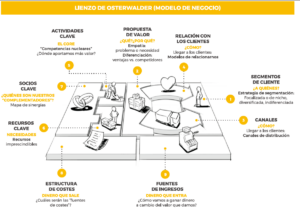
When creating a business model using the Business Model Canvas methodology, you can think of the business model as a story—a story of how your company will create, deliver, and capture value. And like any story, it might be one you’ve heard time and time again.

For example, you can start with what most people emphasize: the value proposition.

If it’s a trip for retirees, the next step is to decide who you can sell it to. It makes sense to define an ideal segment as baby boomers, since the Baby Boomer Generation (1946–1964) comprises people between 56 and 73 years old, characterized by being committed, self-sufficient, and competitive.

The next step is to outline how you will reach them, and yes, that could be through a website. Another point is to define how this will generate revenue, which would involve setting sales fees.

Another question to resolve is what key resources are needed to offer all of this and how we achieve a reliable website with brand recognition.

From this, it may emerge that the key activities will be marketing, the website, and its maintenance. And finally, the other big question is, where will the costs come from? What will sales, the development of the marketing platform, and all of this cost? By resolving all of the above, we could say that we have the first model. But this would only be a step forward.

Predictable models can work, but they rarely provide a competitive advantage. Therefore, one should not settle for a first idea. To compete in a world where the best model wins, one will have to think more and explore alternatives. For example, a prototype of a model where achieving the value proposition can be done at minimal cost or for free.

This will change everything instantly. This realistic model may not be found, but exploring it will force you to think hard about potential alternatives. As an entrepreneur, you must be thinking about the model in a 24/7 environment, that is, all the time. Now, you might think you already have a tool for structuring ideas into rapid prototypes to consider with your team, if needed.

By using this tool, and being optimistic, you could end up with a disruptive model that changes an entire industry, like Skype with its freemium model, or espresso, which became a multi-million dollar business by disrupting such a market and establishing itself as a coffee brewing technique.

In fact, understanding innovative, or simply successful, business models in other industries can be a great way to start achieving your own breakthrough. There’s no right or wrong way to do it, just three rules to get started.

First, focus on the business model. Not just your product, technology, or service.

Second, don’t fall in love with the first models. The best models are built on smart and unexpected elements, and that comes from creating many less obvious versions.

Which leads to the third rule. Interact by testing your models proactively and in a timely manner in the real world. How do you do that? That’s a topic for another time.

The important thing to consider is that if used correctly, Canvases can also serve as prototyping tools.

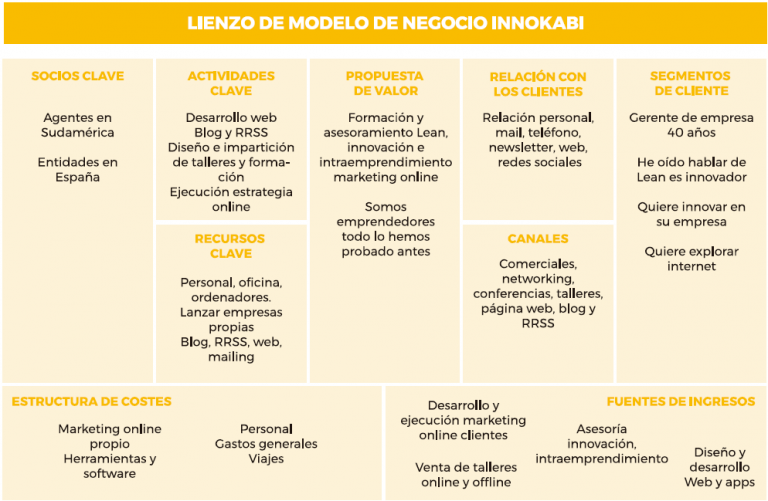
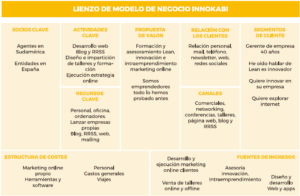
For inspiration, let’s look at the following example from Innokabi, where the canvas is used to develop the business model for their website:

Lean Canvas:

This canvas is based on Lean Startup methodologies. It’s an adaptation of Osterwalder’s model, but for entrepreneurs and innovators just starting out (not established companies). The right side represents the environment (market/society), while the left side represents the product/service.

This canvas uses a launch approach based on validation and scientific experimentation in an interactive way to shorten the processes of developing services/products, measuring progress, and obtaining feedback from target users. It’s best suited for developing services or entrepreneurial initiatives.

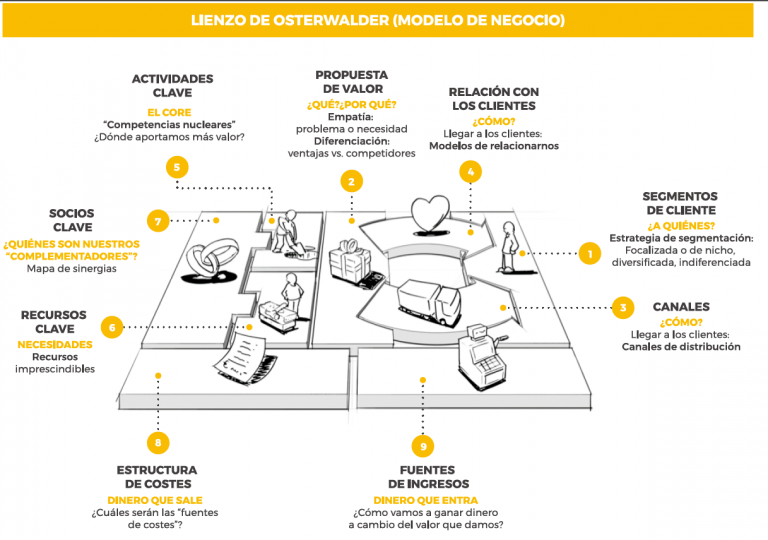
The following figure describes the different blocks of this canvas:

The use of these canvases as prototyping tools for innovation projects is valid and useful for the following reasons:


They serve as «templates» for working on projects collectively. They are very convenient tools for team reflection.

They are a very concise and powerful «visual narrative.» As you progress through them, they are excellent for explaining or communicating the critical aspects of the project.

They help you think in a structured way. They consist of «thinking boxes» that help the team not miss anything important.

They allow you to set the boundaries of the project (product or service) and mitigate the temptation to over-specify it by emphasizing the value perceived by users or beneficiary groups.

Remember that for a project to be viable, it needs proper management of its financial sustainability.
Crazy ideas like Airbnb, Uber, or Snapchat require more than incredible engineering knowledge. Therefore, prototyping crazy ideas can help us succeed, especially in a world where uncertainty reigns.

Bibliografia aqui

Cap 3 Canvas - Creacion de Prototipos

Build a Business That Runs Without You: The Seven Pillars of Clockwork Leadership

Entrepreneurship often begins with a powerful vision: freedom, impact, growth, and the opportunity to build something meaningful. Yet many founders eventually find themselves trapped in a paradox. They create a business to gain freedom, but end up becoming the most overworked employee inside it.
If you’ve ever felt that your company depends too much on you, that you can’t step away without everything slowing down, or that your team waits for your approval before moving forward, this article is for you.

As a leadership and entrepreneurship coach, I want to guide you through a system designed to transform overwhelmed businesses into organizations that operate with precision, consistency, and autonomy. This system is built on seven essential steps that help you shift from being the engine of your business to becoming its architect.


1. The 4D Mix: The DNA of Entrepreneurial Work

Every entrepreneur operates within four core activities: Doing, Deciding, Delegating, and Designing.

Most founders get stuck in the first one—Doing. They execute tasks endlessly, believing that constant action equals progress. But doing without direction leads to burnout, stagnation, and a business that cannot grow beyond the founder’s capacity.

A healthy business requires a strategic balance of these four activities. The recommended mix is:

  • 80% Doing
  • 2% Deciding
  • 8% Delegating
  • 10% Designing

Designing is where true leadership lives. It’s the space where you define goals, create strategies, build systems, and shape the future of your company. When you design, you elevate yourself from operator to visionary.

A founder who only “does” becomes an underpaid employee of their own business. A founder who designs becomes a leader capable of scaling sustainably.


2. Identify Your Queen Bee Role (QBR): The Strategic Heart of the Business

Every business has one critical function that determines its health and long-term success. This function is not a person, a title, or a product—it is a role.
This is known as the Queen Bee Role (QBR).

Just as a hive organizes itself around protecting and serving the queen bee, your business must organize itself around protecting and serving its most essential function.

Your QBR is the activity that:

  • Creates the most value for your customers
  • Aligns with your unique strengths and those of your team
  • Directly impacts the health of the business when neglected
  • Must operate at peak performance at all times

Identifying your QBR is an act of strategic clarity. Ask yourself:

  • Which function, if slowed down, would harm the business?
  • Which activity drives the greatest results?
  • What process must be protected above all else?

Once you identify your QBR, you gain a compass that guides every decision.


3. Protect and Serve the QBR: The Non‑Negotiable Priority

Knowing your QBR is not enough—you must protect it relentlessly.

Every team member should understand:

  • What the QBR is
  • Why it matters
  • How their work supports it
  • What actions strengthen or weaken it

When the QBR is protected, the business flows.
When it is neglected, the business struggles.

Leadership requires communication, alignment, and discipline. You must ensure that systems, resources, and priorities revolve around the QBR. When this happens:

  • Customers receive consistent value
  • The team works with clarity
  • You stop firefighting and start leading

If everything is a priority, nothing is a priority.
Your QBR is the heartbeat of your business—protect it.


4. Capture Your Systems: From Your Head to a Transferable Structure

Many entrepreneurs believe they lack systems, but the truth is that they already have them—they just live in their heads.

Capturing systems means documenting:

  • How tasks are performed
  • In what order
  • With what tools
  • Under what standards
  • With what criteria for success

You don’t need to invent new processes. You simply need to extract what already works and make it teachable.

When you capture systems:

  • Delegation becomes easier
  • Errors decrease
  • Quality becomes consistent
  • Knowledge becomes transferable
  • The business becomes scalable

A business without systems is fragile.
A business with systems is resilient.


5. Balance the Team: The Right People in the Right Roles

A high‑performing business requires a balanced team. This means:

  • Understanding each person’s strengths
  • Eliminating unnecessary tasks
  • Assigning responsibilities based on talent, not habit
  • Adjusting roles as the business evolves
  • Avoiding overload on any single team member

As a coach, I’ve seen businesses transform simply by aligning people with the roles that best fit their natural abilities.
When the team is balanced:

  • Productivity increases
  • Morale improves
  • Turnover decreases
  • Quality rises
  • The QBR is strengthened

A business that runs like clockwork needs a team that operates like an orchestra.


6. Commit: Focus Your Power on the Right Customer

Commitment is not about doing more—it’s about doing what matters.

Many businesses fail because they try to serve everyone. They offer too many services, target too many customer types, and stretch themselves thin. This variability destroys efficiency.

Commitment means:

  • Identifying your ideal customer
  • Defining the specific problem you solve
  • Reducing your offerings to the essentials
  • Eliminating products or services that don’t align
  • Focusing your energy on high‑value impact

When you commit:

  • Your message becomes clearer
  • Your operations become more efficient
  • Your team gains direction
  • Your customers receive exceptional service

Saying “no” becomes a strategic advantage.


7. Become a Business That Runs Like Clockwork

The ultimate goal is freedom.
A business that runs like clockwork:

  • Operates without your constant involvement
  • Produces consistent results
  • Grows sustainably
  • Allows you to design instead of firefight
  • Gives you space to innovate and lead

To achieve this, you need a control dashboard—a tool that allows you to monitor key indicators without micromanaging.

A strong dashboard shows:

  • What’s working
  • What’s not
  • What needs attention
  • What can be delegated
  • What can be automated

When you lead from strategy instead of urgency, your business becomes scalable, predictable, and liberating.


Conclusion: Leadership Is About Designing, Not Just Doing

Entrepreneurship is not about working harder—it’s about working smarter.
It’s not about being indispensable—it’s about building something that thrives without you.
It’s not about control—it’s about leadership.

The seven steps of the Clockwork system are more than operational tools—they are a mindset shift.
A shift from chaos to clarity, from reaction to intention, from survival to growth.


Apply these principles consistently, and your business will stop depending on you…
so you can finally focus on what truly matters: leading, creating, and expanding your impact.

References

Michalowicz, M. (2018). Clockwork: Design your business to run itself. Portfolio/Penguin.
Sinek, S. (2009). Start with why: How great leaders inspire everyone to take action. Penguin Group.
Drucker, P. (2006). The effective executive: The definitive guide to getting the right things done. HarperCollins.
Covey, S. R. (2004). The 7 habits of highly effective people: Powerful lessons in personal change. Free Press.
Blanchard, K., & Johnson, S. (2015). The new one minute manager. William Morrow.

The 7 Pillars to Build a Business That Runs Without You

Using Focused and Diffused Modes

A little bit of Dalí will do you good. Let’s look at some famous people in history who used different ways of thinking to help them solve their problems. One of them was Salvador Dalí, a well-known surrealist painter of the 20th century. He was the very definition of a free and eccentric character.

Salvador Dalí’s eccentric character was reflected in his pets. He was a cat lover, but he chose an ocelot as his furry companion, which he acquired in Colombia in the 1960s. Its name was Babou, and Dalí took it everywhere on a gold chain: to restaurants, he traveled with it on the SS France cruise ship, and they shared a suite at the Palace Hotel.

Dalí used an interesting technique that helped him create his fantastically creative surrealist paintings. He would relax in a chair and let his mind wander, vaguely thinking about something he had previously focused on. He would often hold a key in his hand, moving it just above the floor.

As he began to drift into his dreams, falling asleep, the key would slip from his hand, and the noise would jolt him awake, just in time for him to gather the fuzzy connections and ideas swirling in his mind. Then, he would return to a state of focused concentration, incorporating the new connections he had made while in that fuzzy state.

You might think that’s fine for an artist, but how does this relate to more scientific or mathematical thought processes?

Consider Thomas Edison, one of history’s most brilliant inventors.

Legend has it that Edison would often sit and relax in his chair, holding ball bearings in his hand. He would unwind by freeing his thoughts and mind, though he often ended up thinking about the same things he had been concentrating on earlier, but in a more relaxed way.

When Edison fell asleep, the ball bearing would fall and rattle on the floor, just as it happened with Dalí.

This would awaken Edison, and he would start with the ideas generated in diffuse mode, ready to bring them into focused mode and build upon them.

So, the conclusion is that when you’re learning something new, especially something a bit more difficult, your mind needs to be able to switch between learning modes.

This helps you learn effectively.

This can be somewhat compared to strengthening your muscles by lifting weights.

You would never plan to participate in a weightlifting competition by waiting until the day before to spend the entire day working out like crazy.

I mean, it doesn’t work that way.

To strengthen your muscle structure, you have to do a little work every day, allowing your muscles to grow.

Similarly, to build a neural structure, you have to work a little each day, gradually building a scaffold of neurons to place your thoughts on, a little bit each day. This is the trick.

In short, we must consider that using analogies is a powerful learning technique. We learned about the brain’s two different modes of thinking: focused and diffuse. Each helps us learn, but in very different ways.

With all of this in mind, we must consider that learning something difficult can take time. Your brain needs to alternate between these learning styles as it grapples with and assimilates new material.

Source: Barbara Oakley’s Learning How to Learn Course

Focused Thinking vs Diffuse Thinking

Anxiety in Modern Life: A Call to Reconnect With Our True Self

We live in an era that is both extraordinary and overwhelming. Modern life has gifted us technological breakthroughs, instant access to information, and opportunities that previous generations could hardly imagine. Yet this same world has also pushed us into a relentless pace that, if we don’t learn to navigate consciously, can disconnect us from our deepest essence. As a leader and coach in personal development, I witness every day how this accelerated environment shapes people’s emotional lives, often generating anxiety, stress, and a persistent sense of inner emptiness.

The Disconnection From the Self in a Saturated World

The modern human being often finds themselves distanced from their true identity. Our society is marked by materialism, hedonism, and mass culture. Far from bringing fulfillment, these forces quietly lead us toward a kind of existential decay that manifests as nihilism — the loss of meaning.

Anxiety and stress become everyday companions. They are not minor inconveniences but profound signals that something within us needs attention. Emotional disconnection, excessive competitiveness, and the worship of superficiality all contribute to this discomfort. In the midst of this whirlwind, we stop listening to our authentic needs and allow ourselves to be swept away by what is urgent, forgetting what is truly important.

Anticipatory Anxiety: When the Threat Hasn’t Even Arrived

One of the most common features of modern anxiety is its anticipatory nature. We don’t wait for the problem to appear; we live it ahead of time. A sense of incapacity emerges — the fear that we won’t be able to handle what’s coming — and with it arises a deeper fear: the dissolution of the self.

This constant anticipation drains both mind and body. The person feels that something bad is about to happen, even though they cannot identify what it is. This lack of a concrete object is what differentiates anxiety from fear. Fear responds to a real, identifiable threat. Anxiety, on the other hand, is diffuse, intangible, and yet equally powerful.

As leaders of our own lives, recognizing this pattern is essential. Not to judge ourselves, but to understand ourselves. Anxiety is not an enemy; it is a message. It invites us to pause, observe, and reconnect.

The Need to Return to What Truly Matters

In the midst of external noise, we must recover our inner silence. Modern life has trained us to react, but not to reflect. And without deep reflection, it becomes impossible to build a coherent life project.

Reconnecting with the spiritual — not necessarily in a religious sense, but in a personal, intimate sense — is key to restoring balance. Spirituality, understood as the ability to look inward and ask ourselves who we are, what we want, and where we are going.

As a coach, I’ve seen how this process transforms lives. When someone allows themselves to pause, breathe, and listen, they begin to reclaim their personal power. Anxiety decreases because it stops being an invisible monster and becomes a message we can understand.

Anguish, Fear, and Anxiety: Understanding to Lead

Although anguish and anxiety share common roots, distinguishing them helps us manage them more effectively. From a quantitative perspective, we can also differentiate fear from anxiety:

  • Fear is concrete, objective, and arises in response to a real threat.
  • Anxiety is diffuse, without a precise object, and manifests as constant unease and anticipation of danger.

This distinction is not merely theoretical; it is practical. When we identify whether we are facing a real fear or anticipatory anxiety, we can make more conscious decisions. We can lead our emotions instead of being led by them.

A Call to Inner Leadership

Modern life demands a new kind of leadership: inner leadership. This is not about managing companies or teams — although it can influence that as well — but about guiding ourselves with wisdom, compassion, and clarity.

Leading our own life means:

  • Recognizing our emotions without judgment
  • Distinguishing the urgent from the important
  • Creating spaces for silence and reflection
  • Reconnecting with our core values
  • Building a coherent and authentic life project

Anxiety will never disappear entirely — it is part of the human experience — but it can be transformed into an ally. It can become a compass pointing toward the areas where we need to grow, heal, or change.

Today more than ever, we need conscious leaders. And the first leadership we must exercise is over ourselves.

References (APA Format)

Frankl, V. E. (2004). Man’s search for meaning. Herder.

Fromm, E. (2011). The fear of freedom. Paidós.

May, R. (2017). The meaning of anxiety. Paidós.

Sartre, J.-P. (2005). Being and nothingness. Losada.

Selye, H. (1976). Stress in health and disease. Butterworths.

Anxiety in modern life leading from within

Financial Intelligence for Entrepreneurs:

How to Use the Profit and Loss Statement to Make Better Business Decisions

In entrepreneurship, many decisions are driven by instinct, experience, or urgency. But as a business grows—or struggles—intuition alone is no longer enough. At that point, financial intelligence becomes a critical skill for survival and sustainable growth.

Financial intelligence does not mean becoming an accountant. It means understanding what the numbers are saying, how they are built, and how to use them to make better decisions. One of the most important—and misunderstood—financial reports is the profit and loss statement, also known as the income statement.

Why the Profit and Loss Statement Matters

The P&L shows how well your business performed over a specific period. Unlike the balance sheet, which is a snapshot in time, this report tells a story:

  • How money came in

  • Where it went

  • What actually remained as profit

Entrepreneurs who don’t understand this report often:

  • Confuse revenue with profitability

  • Scale without cost control

  • Make decisions based on cash, not performance

The Structure of the Profit and Loss Statement

Every income statement follows three core sections: revenue, costs and expenses, and profit.


1. Revenue: More Than Just Sales

Revenue reflects money generated from products or services. But a key question is: when is a sale truly recognized?

In long-term contracts, subscriptions, or staged deliveries, revenue recognition involves management judgment. This flexibility can be legitimate—but also misleading if misunderstood.

👉 Entrepreneur tip: Don’t just look at sales numbers. Ask how and when revenue is recognized.


2. Costs and Expenses: Where Profit Is Won or Lost

Cost of Goods Sold (COGS)

Direct costs related to production or service delivery:

  • Materials

  • Direct labor

  • Production costs

What’s included here affects margins and must be applied consistently.

Operating Expenses

All other costs required to run the business:

  • Sales and marketing

  • Administration

  • Rent, systems, depreciation

This section reveals whether the business structure is efficient—or bloated.


3. Profit Levels That Matter

Gross Profit

Shows core business profitability.

Operating Profit (EBIT)

Measures performance from core operations, before financing and taxes.

Net Profit

The bottom line. The true result of strategy, discipline, and execution.


Final Thought

Financial intelligence is about leading with numbers, not reacting to them. The profit and loss statement is not just a report—it’s a management tool.

👉 Entrepreneurs who understand their P&L stop guessing and start leading.

Bibliography

  • Brigham, E. F., & Ehrhardt, M. C. (2020). Financial Management: Theory & Practice. Cengage Learning.

  • Fraser, L. M., & Ormiston, A. (2016). Understanding Financial Statements. Pearson Education.

  • Harvard Business School Publishing. (2014). Financial Intelligence for Entrepreneurs. Harvard Business Review Press.

  • Stickney, C. P., Weil, R. L., Schipper, K., & Francis, J. (2019). Financial Accounting: An Introduction to Concepts, Methods, and Uses. Cengage Learning.

Profit and Loss Statement – Practical example

Success Doesn’t Start at School — It Starts with Responsibility

In a world obsessed with quick success, we often search for formulas, tools, and shortcuts to guarantee happiness and professional achievement. Yet one of the longest and most comprehensive studies in human history reveals that the foundation of success is far simpler — and far more overlooked.

For decades, we have searched relentlessly for the formula for success: better schools, higher degrees, more connections, more technology. Yet one of the longest and most rigorous studies in human history challenges this belief at its core. Success, it turns out, does not begin with intelligence or privilege. It begins with responsibility.

In 1938, researchers at Harvard University launched what would later become known as the Grant Study, a longitudinal project that followed the lives of 724 individuals from adolescence until death. For more than 85 years, researchers examined their mental health, relationships, careers, income levels, failures, and personal struggles, all in pursuit of one essential question: What truly makes a person successful and happy?

The answer surprised everyone.

Neither IQ, academic performance, nor family wealth proved to be the strongest predictors of success. Instead, one of the most powerful indicators of long-term professional and personal achievement was something remarkably simple: doing household chores during childhood.

At first glance, this may seem insignificant. In reality, it is profound.

Taking out the trash, washing dishes, or setting the table is not merely about cleanliness. These activities function as early psychological training. The study revealed that chores instill what researchers called an “ethic of contribution” — the understanding that one’s effort matters and that being part of a system requires participation.

When a child pauses playtime to fulfill a responsibility, they internalize a fundamental truth of adult life: the world does not revolve around them. They learn accountability, cooperation, and purpose — not through lectures, but through lived experience.

As adults, those children were more likely to:

  • Take initiative without being asked.

  • Show empathy for the effort of others.

  • Handle frustration with resilience.

  • Delay gratification and persist through difficulty.

Ironically, these are precisely the traits sought by employers, leaders, and high-performance teams today. And yet, they are rarely taught in classrooms. They are cultivated through responsibility.

We now live in the era of “helicopter parenting,” where boredom, effort, and discomfort are actively avoided. Children are shielded from routine tasks in the name of convenience or protection. However, Harvard’s findings are clear: by removing children from mundane responsibilities, we undermine the very foundation of their future competence.

This lesson extends far beyond parenting. Many adults who seek personal growth desire extraordinary outcomes while avoiding ordinary discipline. They want fulfillment without effort, achievement without responsibility. But sustainable success is not built in dramatic moments; it is formed in quiet, consistent habits.

Sometimes the most powerful lesson isn’t another educational toy or course.
Sometimes it’s a responsibility.


Because success isn’t taught through speeches.
It’s built through habits.

Growth requires embracing what is repetitive, uncomfortable, and often unnoticed. Responsibility — especially when no one is watching — is what shapes character.

Because in the end, success is not taught.
It is practiced.
And practice begins with taking responsibility, even in the smallest things.

References

Vaillant, G. E. (2012). Triumphs of experience: The men of the Harvard Grant Study. Belknap Press of Harvard University Press.

Harvard Medical School. (2017). The Harvard Study of Adult Development. https://adultdevelopment.hsph.harvard.edu

The ethics of contribution: the true training for leadership.

Persuasion: The Invisible Skill That Shapes Decisions and Elevates Leadership

In a world overloaded with information, constant choices, and increasing cognitive demands, persuasion has become an essential skill for leaders and entrepreneurs who want to influence with integrity and communicate with impact. Every day, we respond to mental shortcuts designed to help us save time and energy. Understanding these triggers not only protects us from unwanted influence but empowers us to lead more consciously and effectively.

Ethologists have found that both animals and humans follow fixed-action patterns—automatic responses triggered by a single element. In business and leadership, recognizing these “mental clicks” helps us guide decisions with clarity rather than reacting blindly.

1. Reciprocity: The Power of Giving First

One of the strongest principles of influence is reciprocity. When someone gives us something, we feel compelled to return the favor. As leaders, giving value before expecting anything in return builds trust and opens doors. Yet we must also stay aware of “strategic favors” meant to manipulate rather than contribute.

2. Liking: The Influence of Similarity and Genuine Connection

People say yes more easily to those they like. Sometimes that liking is influenced by attractiveness or similarities. True leaders do not exploit this—they cultivate real connection, authenticity, and empathy. Liking is powerful when born from sincerity, not performance.

3. Social Proof: The Power of the Many

When we feel uncertain, we look to others. Testimonials, reviews, and community behavior guide decision-making. But leaders must learn when the majority is right—and when it isn’t. Great leadership involves discernment, not conformity.

4. Authority: Knowledge Over Position

Authority influences in two forms:

  1. Role-based authority, which often triggers resistance.

  2. Expert authority, which inspires trust.
    Real influence arises from credibility, transparency, and a willingness to admit small flaws before presenting strengths. Honesty builds stronger authority than titles ever could.

5. Scarcity: Value in the Limited

Scarcity increases desire. But leaders who make decisions under pressure must differentiate real opportunity from emotional urgency. Awareness turns anxiety into strategic clarity.

6. Consistency: Commitments That Shape Behavior

Humans want to stay consistent with their previous decisions. This helps develop habits, loyalty, and long-term goals. However, leaders must remain aware of when consistency becomes stubbornness or misalignment.

7. Unity: The Power of “Us”

People support those they perceive as part of their group. Building community and shared identity is one of the most ethical and effective ways to inspire action. Unity converts followers into partners and teams into movements.


Final conclusion

Persuasion is not about control—it’s about clarity, service, and vision.
Lead with intention, influence with integrity, and people will follow not because they must, but because they believe.

References

Cialdini, R. B. (2021). Influence: The Psychology of Persuasion (New and Expanded Edition). Harper Business.
Cialdini, R. B. (2009). Yes! 50 Scientifically Proven Ways to Be Persuasive. Free Press.
Kahneman, D. (2011). Thinking, Fast and Slow. Farrar, Straus & Giroux.

The Weapons of Influence in Modern Entrepreneurship and Leadership